

8 Things to Do on an Exploratory Trip to Canada Before Immigrating
| Updated in August 2026. The eight steps of this itinerary remain valid, the logic of an exploratory trip does not change. The dates that appear in the text refer to my own trip, in 2017, and remain as a report. Two things to adjust in your planning today: (1) Brazilians still need visitor visa to enter Canada (the eTA is not enough, which is only valid for those arriving by plane and have already had a Canadian visa or a valid American visa), start this process well in advance; (2) accommodation and food costs have risen a lot since 2017, so add at least 40% to the budget you saw in old blog reports. See also How much does it cost to live in Canada in 2026? |
When is it worth investing in an exploratory trip to Canada?
Firstly and for more than obvious reasons, it is when you have the means to do so. With the current global economic situation, it is not easy for anyone. And being very honest with you, reader, for this type of experience to work it requires a high investment, as travel and accommodation in Canada are far from being a bargain for Brazilians.
Secondly, when you have exhausted your research on the country, culture and opportunities for the whole family, but still, you follow the line of São Tomé, the one who only believes by seeing it with his own eyes. In fact, it was exactly for this reason that my wife and I decided to go on this family adventure in July 2017. At that time, you could count on one hand who made free content on the internet about what it was like to live in Canada.

Family in Montreal summer 2017 - Source: Personal archive
I myself have always been suspicious of these people who liked to write things about immigrating to Canada, always with the ulterior motive of selling something (laughs). That’s a lot of nerve from this author, who had his first job in Canada as a content manager for an immigration consultancy.
How can an exploratory trip to Canada help in my decision to immigrate?
If you are currently going through the same stage we went through between 2016 and 2017 and really need to see and live the experience, I’m sure your biggest question before immigrating to Canada is where you will live.
This is a more complex challenge for 10 out of 10 people who start a project to leave Brazil, after all, I am going to leave behind my home, my comfort zone and my family to start over in a totally different place without ever having set foot there before.
I know that there are a lot of people who don’t care about this and who even enjoy the experience of living an adventure without worrying so much about how they will adapt, but in our case, my wife and I were already over 40 years old and had two teenage daughters in tow. Therefore, we wanted to minimize risks before making such an important decision.
That said, I will try to summarize our experience by leaving tips on how to make the most of this type of trip. So, here are the 8 things you need to do on an exploratory trip to Canada if you intend to immigrate.
1. Visit different cities and regions in Canada
Canada is a huge and diverse country, with many distinct cities and regions. Visit different cities and regions to get a feel for the lifestyle, job opportunities and living conditions in different parts of the country.
Try to include at least 3 or 4 different cities in your itinerary to get a better idea of what you are looking for, but do your homework beforehand, filtering the candidate cities as much as possible. If possible, stratify further by going down to the neighborhood level, as cities like Montreal and Toronto are huge and it won’t be possible to cover everything. On our exploratory trip we chose central and eastern Canada, focusing on the provinces of Quebec and Ontario. In them, we spent 7 days in Toronto, 3 days in Quebec City and 10 days in Montreal (a city where we had Brazilian friends living for a few years)
TIP: Focus on the East or Midwest
2. Avoid using a car during your exploratory trip
Ok, I know this tip may seem difficult to follow, as not everyone will have a lot of time to travel. Just keep in mind that if your goal is to have a real experience of living like a native, using public transport will be essential to prepare yourself for what’s to come, especially in larger cities like Montreal, Toronto and Vancouver.
Also read: “How to use public transport in Montreal”
Among the cities where it is possible to use public transport with certain facilities (depending on the weather) are:
- Toronto – 2,731,571 inhabitants (It has a subway network)
- Montreal – 1,704,694 people (It has a subway network)
- Calgary – 1,239,220 residents
- Ottawa – 934,243 inhabitants
- Edmonton – 932,546 residents
- Mississauga – 721,599 inhabitants
- Winnipeg – 705,224 residents
- Vancouver 631,486 people (It has a subway network)
- Brampton – 593,638 inhabitants
- Hamilton – 536,917 residents
- Quebec City – 531,902 inhabitants
- Surrey – 517,887 people
- Laval – 422,993 residents
- Halifax – 403,131 residents
- London – 383,822 inhabitants
If you intend to live in smaller cities that are not well served by public transport, traveling by car would be the best option. On my trip I only rented a car for 3 days to move between the cities of Montreal and Quebec City in the province of Quebec. Between Toronto and Montreal we took a domestic flight, as it would be at least 6 hours by car.
Read also: “Learn the difficult art of parking in Montreal: Complete Guide”
3. Stay in AIRBNB-type apartments or at a friend’s house
Well, getting straight to the point, if you don’t have friends or relatives who can take you in, avoid staying in hotels. And the reason is simple, besides the hotel costing more, you will only experience a local Canadian lifestyle if you go to the supermarket and cook on your own.
But wait? Wasn’t it supposed to be a trip to enjoy a new country? Of course you do, but remember that you’re not going on vacation, your main objective on this adventure is to get a preview of what you’re going to face. So, you have to do it without the perks of a hotel.
I remember well on our trip how we went through hilarious situations of not knowing what to buy, and being astonished at the prices of products, both more and less compared to Brazil. Things that are strange to our culture, like not being able to buy alcoholic drinks in the supermarket or convenience stores and many others.
Read also: “Discover 17 very strange laws in Quebec for newcomers”
Staying at a friend’s house or in a seasonal apartment will give you a much more realistic idea of the neighborhood, the neighborhood and the peculiarities of using household appliances in Canada.
4. Try local food in Canada
Well, this one will be very difficult to do, as anyone who has had any experience traveling in the USA will not be as surprised by Canadian cuisine. In fact, both countries share the same taste for fast food and very heavy meals.

Poutine, typical dish in Canada - Credits: withlovefromchileA good example of heavy food is the famous Poutine (originally created in Quebec). When I arrived, right at the beginning of winter, this little food was like a “consolation” for the cold you got on the street, but today I stay away from it. It’s practically on every cafeteria menu in Canada, including McDonalds. Some Canadian doctors “affectionately” call it Heart Attack Food. And don’t be surprised to see some parents giving it to their young children.
I also want to say that there is a wide variety of menus in the country and not just the Heart Attack Food, but you will only find it in big cities like Toronto, Montreal and Vancouver, the darlings of food Reality Shows on TV and the Internet. Mainly due to the great multicultural influence of other immigrants.
Outside of this axis, go with an open mind and body to eat typical American food, filled with lots of carbohydrates, saturated fat, sugar and strong peppery seasonings. So, remember my advice about cooking on your own? Well, if you’re not a big fan of McDonalds, this could save your life during your stay in Canada.
In large cities there is also an incredible variety of supermarkets specializing in ethnic foods (including those from Brazil), but they may not be very close and accessible to you if you are using public transport. I remember that we even made some attempts to see if we could find items that we normally use in Brazil and we even managed to get some, but I confess that it was not easy to do this by bus or metro. In any case, the experience was worth it.
Read also: “Quebec for Brazilian newcomers: Tips on local culture”
5. Try to travel to Canada at the best time
And when would that be? Of course at any time outside of cold or freezing winter! More precisely between the second half of May and the end of September. And why not in winter? Shouldn’t I already feel what it’s like to live in the real cold before deciding to move to Canada? Of course! If you do that, it’s unlikely you’ll come back (laughs).
And please don’t do this nonsense unless you are a lover of the cold, snow and winter sports, characteristics that only a few native Canadians possess. Believe! Not even the Canadians like winter, but what can they do? It’s a good place to live and raise children.

Dressed as a street sweeper to see Niagara Falls up close - Source: Personal archive
Plus, no matter how hard you try to know what it’s like to live in a Canadian winter, doing it for 10 or 20 days won’t be enough. Only by going through it in its entirety (like 4 or 5 months depending on the region) will you get an exact idea.
Read also: “Is Canada better prepared for the intense cold than the USA?”
Traveling on vacation to Canada during the most intense winter (December to March) will only make the process of recognizing cities and neighborhoods more difficult, as there are not many options for outdoor programs and getting around using public transport will be very challenging for those who do not have this experience outside of winter. Furthermore, this goes hand in hand with my advice number 2 (use public transport).
We visited Canada between June 20th and July 10th and it was incredible, but I must emphasize that this is one of the most expensive times to come, as it is when the school break begins, lasting until the end of August. As the Canadian dollar exchange rate was very good at the time (around R$2.60) the cost of tickets and accommodation was less painful.
 Tip! Tip!Traveling to Canada between May and August has many advantages, but the one I consider most important are the longer days. You will notice that the sun starts to wake up before 6am and only goes away after 9pm. For those who are doing tourism there is nothing better than long days. During winter, daylight begins after 8 am and ends before 4 pm. Try to make your tourism productive with this time arrangement and see how challenging it can be. |
6. Explore neighborhoods and schools for your children
This advice only applies to those with children, so if you don’t have them, skip this part. Now, if you’re on my team, here’s a golden tip. Set aside some time to visit neighborhoods where you have already researched schools for your children. Don’t be like me, who simply ignored this and got into trouble with my daughters’ school freshman year.

Old Port in Montreal - Source: Personal archive
Few people know, but the school where your child will study will depend on the neighborhood where they will live. Unlike Brazil, we do not have the power to choose. So, do your homework before visiting the destination city of your project by researching schools in the national grade ranking. Go to the neighborhoods and around the schools you selected to get your own impressions. I would even say, if possible, stay in that neighborhood or somewhere closer to the school to see what you think of the neighborhood.
If Quebec is an option for you, I suggest this text here: “How does the school system work in Quebec?“
7. Make connections and build a network during the exploratory trip
This was one of the best lessons I learned from my exploratory trip to Canada and you will soon understand why. As usual, in the home of a Brazilian immigrant, there will always be more Brazilians than you expect to find, and that was my case.
Well, during my stay in Montreal, I went to a party at the house of a friend who graduated with me in Brazil. There were at least 3 more families at different stages of immigration. Some are already permanent residents or citizens, others are still at the College stage and others are starting their professional lives in Canada.
Meeting these people face to face gave me a lot of insight into what kind of plan and actions I could choose before immigrating. This type of Networking was fundamental for me, as 2 people who were present at the party were from the IT area (the same one I worked in Brazil).
And to be quite honest, seeing a YouTuber talking about Canada is one thing, talking to real people who are there, more relaxed and without masks because of a few too many beers, is quite another. I think every self-respecting Brazilian knows what I mean by that.
This network of friends that I created when I visited Canada in 2017 played a very important role when we actually arrived the following year. They were the ones who supported us in the first days, they were the ones who helped us adapt and, more than that, they were the ones who became our family in the frozen lands of the north.

First picnic of spring 2019 with the new family. Source: Personal archive
I know that not everyone will be able to count on this network, whether it is made by Brazilians or not, but keep in mind that making connections during your trip can be one of the biggest keys to the success of immigrating, regardless of the country you choose.
8. Explore all the good things the city or neighborhood has to offer
Finally, here’s my last piece of advice. Canada is far from being a perfect country, even with a small population, there are many cultural contrasts due to immigration and the economic problems that have plagued the world after the pandemic and wars.
So, don’t expect to find a beautiful, wonderful country where everything works in perfect harmony. Here you will find rude people, beggars begging and sleeping on the floor and even some dirty places like in Brazil, rules and laws that are incomprehensible at first glance. But on the other hand, much, much less violence and crime than our beloved homeland. Not to mention the opportunities for personal and professional growth.
Try to come with an open heart and mind to a culture that is still being formed, as much of the Canadian identity is imported from other cultures. The few exceptions you will see are in Quebec, as they are indeed a separate case.
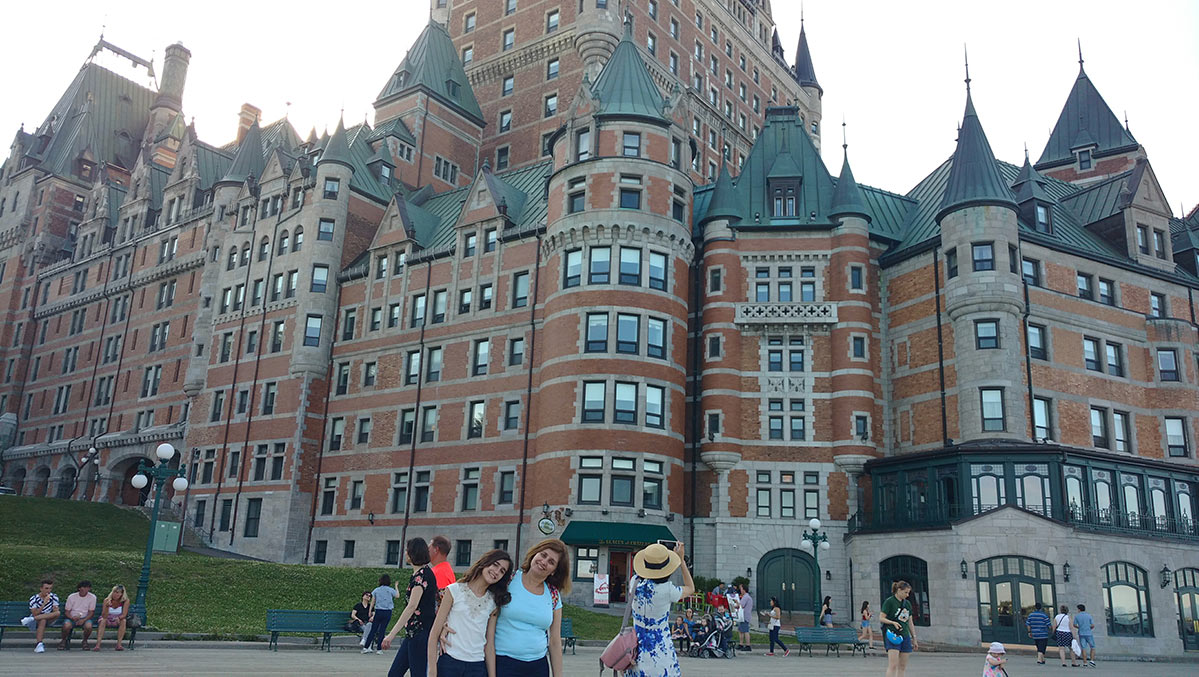
Quebec City summer 2017 - Source: Personal archive
If you can come during a period where festivals are taking place, be sure to include this in your schedule. Whenever we see the best of a country, it becomes much easier to bear its bad side (the cold, of course). As Brazilians, we know this very well.
Living your best life on an exploratory trip to Canada will help you face winter as a difficult phase, but one that passes and soon brings many rewards to those who resist. I myself arrived with suitcases and care during the winter, but even with the shock of this turn of events, I already knew what to expect when the cold went away. I’ve seen a lot of people depressed and without hope after about 2 months of winter here, believe me.
I often joke with a lot of people that if the Canadian summer lasted all year round, the country would already explode with a migratory overpopulation. Winter is the only thing capable of keeping everything under control.
F.A.Q. - Frequently asked questions about tourism in Canada
Do I need a visa to visit Canada?
Yes, Brazilians need a visitor visa to enter Canada as a tourist. It costs $150 CAD and can be done with a little patience completely online at official Canadian immigration website, IRCC.
Canada also allows entry to Brazilians holding a valid US tourist visa. In this case, the process is much simpler and cheaper ($7 CAD), as you will need to apply online for an eTA (Electronic Travel Authorization).
How many days should I stay on an exploratory trip?
Try to stay at least two weeks, if you choose 3 cities, the ideal would be a week in each of them. If you don’t have the money and time for this, reduce the number of cities if you can’t stay at least 5 days in each of them.
How much money should I bring to tour in Canada?
As there is no consensus on this matter, as it depends on each person’s lifestyle, I will stick to how much you will spend per day to eat, move around and do some activities. For this, I will use Montreal as a reference, as it is not possible to generalize when it comes to travel costs.
Most common expenses for travelers:* 1 pass to travel on public transport - $29 CAD (STM multi week pass)
- 1 Individual dish in an average restaurant (without alcohol) - Between $30 to $50 CAD + tax and tip *
- Passport Montreal with 5 attractions - $80 CAD + taxes *
- Grocery shopping for a week’s worth of breakfast and small snacks and no alcohol (2 adults) - $150 to $250 CAD.
- Average price of 1 night (couple) at AIRBNB for 8 days in Montreal in June - $200 CAD
- Flight ticket between São Paulo and Toronto on a direct flight in the month of June (01/06 to 08/06) - R$ 5,100
* Please note that prices may change as this post becomes outdated.
If drinking in bars and restaurants in Montreal, consider spending between $8 and $14 CAD for each pint of beer plus tip and tax. You will soon discover that buying some beer and wine at the supermarket to drink at home will greatly ease your bill.
I’m also not including any purchases in this travel bill, after all, if you’re going to live there, why would you already increase this loss if you haven’t even gotten there yet. Expect to earn in dollars first.
| Alert! Be aware of the taxes you need to add when paying a bill in Canada. In the province of Quebec, for example, any purchase of goods and services will be increased by 15% to the prices listed on a menu or supermarket shelves. And speaking of the menu, I need to say that not tipping for almost all services you use in Canada is considered extremely rude. This tip, as they call it, varies from 10 to 35%. Stay at 15% to avoid mistakes. |
What time of year should I visit Canada?
Definitely between May 15th and September 30th. Canadian spring (March 21st to June 21st) is the biggest prank a tourist can fall for. The temperature only starts to become pleasant in the second half of May (like 18º to 20º C if you’re lucky). Also avoid November, the days are very short, the cities look like something out of a horror movie, with leafless trees and freezing cold.
The exciting events and everything else that happens in Canada only starts from that time onwards. This is if we consider that we are talking about cities further south in Canada like Montreal and Toronto. Vancouver has a milder climate than the two, but don’t be fooled by the wetter cold, because even without so much snow, it rains a lot there. I visited the city in the spring and interestingly it was colder than Montreal.
And for those who were waiting for me to talk about summer and fall, here’s some advice. The Canadian summer can be very unpleasant at its peak (July to August) with weeks in which the temperature can reach 40º C. In this climate, the ideal is to immerse yourself in nature in the hundreds of rivers, lakes and waterfalls in Canada.
Autumn is really beautiful and is really impressive to see with all those colors, but what many people don’t know is that all the glamor of this season ends when you discover that, in addition to the cold, you will have many humid days due to heavy rain. If you’re lucky enough to catch a few days of sunshine on your trip, it will be unforgettable, but I wouldn’t recommend this season of the year for an exploratory trip to Canada, I’d leave it to enjoy it if you decide to live there, you’ll need time to see it happen.### What clothes should I wear while traveling to Canada?
The following rules only apply to cities in southern Canada such as Montreal, Toronto or Vancouver. For other locations, especially further north, it is important to consult the local temperatures at the times I will list below.
From May to June: Light and casual clothes for the day, alternated with light jackets or sweatshirts for the late afternoon and evening.
From July to August: Light and casual clothes for our Brazilian summer, as it is very hot. Bringing a swimsuit is a good idea. You will find the ones here very ugly and expensive if you have to buy them, believe me.
From September to October: Light and casual clothes for the day, but with a little more layers due to the wind. At night, coats for mild or moderate cold, as it can get very cold during autumn. So much so that it is not strange to see days when the thermometer will reach close to zero.
Final considerations
An exploratory trip can be a smart choice if it fits your budget. Research and consultancy help, but nothing replaces walking around the neighborhood, testing the transport, going into a supermarket and feeling for a few days how the routine really works. Just don’t confuse a visit with permanent life: ten days show a lot, but they don’t replicate an entire winter or the pressure of looking for work and housing.
Know the country’s laws and rules, visit different cities and regions, learn about work and study opportunities, make important connections, try local cuisine, evaluate living conditions, visit an immigrant community and be open to new experiences.
Well, I hope these tips help you make the most of your exploratory trip to Canada and make an informed decision about your immigration.
If you want more tips like these, sign up for our newsletter to receive updates about life in Canada, especially in Quebec and Montreal.
See you in the next post! 😉

Marco Vasconcelos
Brazilian, webmaster, and e-commerce specialist living in Montreal since 2018. Founder of Você no Quebec, sharing practical guides, housing tips, and real-life experiences in the province to help Brazilian and international newcomers transition smoothly.
Read more about Marco →