What changes for you with permanent residency in Canada
Editorial review: August 2026. Immigration rules change frequently and vary according to the profile. Use this guide to understand the process, but confirm forms, deadlines, and eligibility on the official portals of Canada and Quebec before submitting an application.
It’s not enough just to arrive, you have to want it
It seems silly, but many people who arrive in Canada only start worrying about permanent residency after a good while of being here, something quite understandable, since some people need time to adapt and digest this new environment. Believe me, not everyone arrives so sure that they will stay, and even less so that they will become permanent residents in this new country.
I won’t deny that I thought that way myself. I didn’t arrive here certain of everything, mainly because I made this crossing at age 43 and with two teenage daughters in tow, leaving a stable life in Brazil to restart my whole life in a hellish cold. Without false modesty, I challenge that few people face it in this condition and age. In fact, very few, as forty-somethings like me represent less than 10% of the regular immigration flow to Canada, which mostly prioritizes candidates in the 25 to 30 age range. But that’s a topic for another post, so let’s get to what really matters, this so-called Permanent Residency.
What is permanent residency in Canada?
Basically, a permanent resident (PR) of Canada is a person who immigrated to the country and was granted permanent resident status through a long and bureaucratic process with the Canadian immigration department, better known as Immigration, Refugees and Citizenship Canada (or IRCC to its friends). And what does this mean in practice? It means that from this status you will no longer need a visa or temporary residence permit to live (study or work) in Canada and, as long as you maintain your PR status, you can remain in Canada indefinitely.
As a permanent resident, you are still a citizen of another country, but after meeting the physical residency requirement and other eligibility criteria for Canadian citizenship, you can qualify to apply for citizenship. That being said, permanent residents enjoy most of the rights and freedoms granted to Canadian citizens, with a few exceptions.
Typically, permanent resident status is granted for five years. If you don’t apply for citizenship during this time, you can renew your PR status as long as you have lived in Canada for at least two of the previous five years.
What is the best way to become a permanent resident in Canada?
For those waiting for a straightforward guide, I’ll let you know right away that there is no cookie-cutter recipe for this. You can’t summarize the more than 50 different types of processes to get a PR in Canada in one post. The IRCC website itself has difficulty with this, let alone me here. If it were like that, there wouldn’t be jobs for immigration consultants.
Thus, either you arrive as a PR or you become a PR after you have been living as a temporary resident in Canada for a while.
And what is the easiest way to do this? Of course, it’s arriving in Canada as a PR, but that is a stream for a few, only candidates within a very special profile. Generally, people with a high level of language proficiency (English, French, or both), an academic background at a postgraduate or master’s level, as well as outstanding professional experience. Well, now that you know this, answer quickly, how many people like that (enjoying an age under 30) do you know in Brazil?
Is there a possibility of arriving as a PR in Canada with low qualifications? Yes, I already knew you were going to ask that. Remember the more than 50 different processes I mentioned? Not all of them are geared towards super candidates and they can open up spots for you to arrive here without having advanced language skills or a super resume. Just keep in mind that the chances of you having to live in a small town, certainly further north, more isolated, and with temperatures even lower than average, will be very high.
If living near polar bears and far from large urban centers like Montreal, Toronto, Alberta, or Vancouver is not a problem, you can pack your bags. Do you understand now why so many temporary residents who arrive here as skilled workers or students become permanent residents in Canada after a while? A good part of them are not willing to give up starting their lives in Canada near the large centers, so they choose to enter as a temporary resident.
Read also: “Challenges of settling in a smaller city in Canada”
Arriving as a temporary resident has its disadvantages, because in this condition you have more duties than rights. However, this has been the most sought-after entry point by those who do not meet the super candidate filter. Will it cost more? Sure, but for many (and I include myself in this), the process has to be seen as a short-to-medium-term investment, considering that you can become a PR in just over 2 or 3 years. So, let’s leave this topic aside and continue with our main theme.
What are the differences between temporary and permanent residency in Canada?
Although the temporary and permanent residency programs allow newcomers to enter and live in Canada, the particularities of these statuses differ significantly. The most important difference is that temporary residents, including work permit and study permit holders, cannot continue to stay in Canada beyond the validity of their permit and visa. Here is an overview of how temporary and permanent residency in Canada differ:
| Permanent residency | Temporary residency | |
|---|---|---|
| Renewing your status | Status can be renewed on an ongoing basis as long as you meet the criteria to maintain your PR status. | Your status in Canada is valid for the duration of your work or study permit. You must leave Canada after your permit and/or visa expires. In some cases, you may be able to extend or reapply for temporary residency or qualify for PR. |
| Working and studying in Canada | Permanent residents can work freely for any employer in Canada or enroll in any study program at a Canadian university or college. PRs pay domestic tuition, which is much lower than for international students. | Temporary residents require a permit to work or study in Canada. These permits can restrict the number of hours you can work, the work you can do, and the employer you can work for. International students must pay a higher tuition fee compared to domestic students. |
| Your rights | Permanent residents enjoy most of the rights that apply to citizens, with a few exceptions. | Temporary residents cannot vote in Canada, may not be covered by all social benefits, and may face restrictions on their ability to work, study, or move. For example, in many provinces, international students are not covered by provincial healthcare. |
Source: IRCC
Is permanent residency the same as Canadian citizenship?
Permanent residency in Canada is different from Canadian citizenship in several ways, including:
- Citizenship status lasts forever, but your permanent residency must be maintained and renewed. For example, if you are a permanent resident of Canada and decide to return to your home country for a few years, you may not be able to renew your PR status if you do not meet the physical residency requirement.
- Canadian citizens enjoy certain rights that permanent residents are not eligible for. For example, unlike a permanent resident, citizens can vote in elections, obtain a Canadian passport, or run for public office in Canada.
- A child born abroad to a Canadian citizen is eligible for Canadian citizenship from birth. However, if a Canadian permanent resident gives birth outside of Canada, the child does not automatically qualify for citizenship.
As a permanent resident, you can qualify for citizenship after meeting the minimum physical residency requirement of 1,095 days (or three full years). Note that if you lived in Canada before becoming a permanent resident, you may be eligible to partially count that time as well. You must also meet other eligibility criteria, such as passing the citizenship test, proving your language ability, filing taxes (usually for three years), and taking the oath of citizenship.
What is a Canadian permanent resident card?
A permanent resident card is an identification card that proves your permanent resident status in Canada. This would be the Canadian equivalent of the famous US Green Card. You will also need your PR card, along with your foreign passport, to re-enter Canada after traveling to a different country.
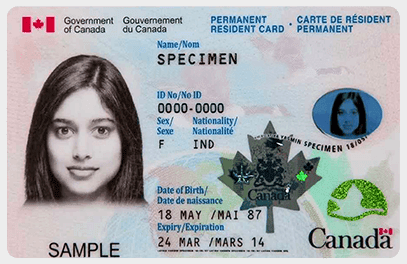
Example of a PR Card in Canada - Source: IRCC (2015 Version)
Your PR card (or your Confirmation of Permanent Residence) can also be shown as proof of your status in Canada when you apply for provincial health insurance, a Canadian driver’s license, to register your children in school, or for certain financial products.
Not to mention the ease of entering and leaving Canada with this little card. Anyone who has traveled to Brazil or other countries as a temporary resident on Canadian soil knows how inconvenient and even stressful it can be to explain to the immigration officer what you do in Canada, where you live, where you work or study, in addition to having to carry a folder with your life dossier every time you travel.
I remember well the hell it was being stuck here during the COVID pandemic. Only permanent residents could freely enter and leave Canada.
How can I get a permanent resident card?
You can only get a permanent resident card if you have been selected for permanent residency in Canada. To get your permanent resident card, you must first come to Canada with your Confirmation of Permanent Residence (CoPR) and passport. Depending on which country you are immigrating from, you may also need a visa or an Electronic Travel Authorization (eTA) to enter Canada.
At your port of entry, which can be the airport or the Canadian border, immigration officers will review your documents and conduct a brief interview before processing your PR card application. You will need to provide a Canadian address (this can be your temporary accommodation address) and you will receive your permanent resident card in the mail in a few weeks.
If you are already living in Canada with temporary status through a work permit or study permit and have just been approved for permanent residency, you will receive an email communication from IRCC to confirm your PR status virtually, through the IRCC portal.
| Note: If you did not provide a Canadian address when you landed in Canada, you must do so within 180 days after becoming a permanent resident. Otherwise, IRCC will cancel your PR card and you will need to submit an application and pay a processing fee to get one. |
Your rights as a permanent resident of Canada
Once you become a permanent resident of Canada, you will enjoy certain rights and freedoms in the country. These include:
- The freedom to travel and live anywhere in Canada without restrictions.
- Access to social benefits, including publicly funded healthcare in your province, free public education for children, etc.
- Financial and tax benefits and credits for eligible permanent residents, including registration in programs like Old Age Security (OAS), Canadian Pension Plan/Quebec Pension Plan (based on your employment status), Canada Child Benefit (CCB) and more.
- The possibility to buy a house in Canada without the general restriction applied to many non-Canadians. Federal law has exceptions and effective dates that can change. Consult the updated text of the federal law and obtain legal advice before signing any promise to purchase.
Read also: Immigration Minister reinforces criteria for family reunification in Quebec
- The freedom to work for any employer in Canada. You must, of course, go through the employer’s recruitment process and obtain a job offer first. However, Canadian employers do not need a Labour Market Impact Assessment (LMIA) to hire a permanent resident.
- The freedom to study at any university or college in Canada. Educational institutions have different eligibility criteria and you must first be accepted into a study program and pay domestic fees, which in practice means paying less than a tenth of the amount charged to international students.
- The opportunity to qualify for Canadian citizenship after meeting physical residency and other requirements.
- Freedom and protection under Canadian law and the Canadian Charter of Rights and Freedoms.
- You have the right to initiate a sponsorship process for a spouse, parents, and children, and can extend permanent residency to them.
Your responsibilities as a permanent resident of Canada
Permanent residency in Canada also comes with certain responsibilities, such as:
- Payment of income tax and other indirect taxes, including Goods and Services Tax (GST) and Harmonized Sales Tax (HST).
- Respecting all federal, provincial, and municipal laws.
- Maintaining your PR status. To do this, you must be physically present in Canada for at least 730 days during the five-year validity of your permanent resident card.
Restrictions for permanent residents in Canada
Some restrictions apply to permanent residents in Canada. These are things that only Canadian citizens have the right to do, but not permanent residents, such as:
- You cannot vote in federal, provincial, or municipal elections.
- You cannot run for political office.
- You cannot obtain a Canadian passport.
- You cannot qualify for jobs that require high-level security clearance.
- You cannot be called for jury duty.
How to maintain your permanent resident status in Canada
Unlike citizenship, your status as a permanent resident of Canada must be maintained. To maintain your permanent resident status, you must be physically present in Canada for at least 730 days (two years) during the last five years. The 730 days do not need to be continuous.
In some cases, time spent outside of Canada can also count towards your physical residency requirement to maintain your PR status, such as:
- If you were working abroad full-time for a Canadian organization or government.
- If you traveled abroad with your spouse or partner who is a Canadian citizen or a permanent resident working abroad full-time for a Canadian company or government.
- If you are a dependent child traveling abroad with a parent who is a Canadian citizen or a PR working abroad full-time for a Canadian company or government.
| Important information: Once you become a citizen of Canada, you no longer need to meet any physical residency requirement. However, you may need to be physically present in your province or territory for a certain period each year to maintain your eligibility for social benefits, such as provincial health coverage. |
Read also: “How to apply for your health card in Quebec (RAMQ)“
How to renew your permanent resident card in Canada
Your PR card is normally valid for five years, and many newcomers will apply for and receive Canadian citizenship during this time. However, if you don’t qualify or don’t plan to apply for citizenship, you may need to renew your permanent resident card.
You can only renew your PR card if you meet all of the following criteria:
- You maintained physical residency in Canada for at least 730 days in the previous five-year period.
- Your PR card has expired or is about to expire in the next nine months.
- You have not lost or renounced your PR status or become a Canadian citizen.
- You are currently in Canada.
To renew your permanent resident card, you will need to submit an online application through the IRCC portal and pay a $50 CAD processing fee.
Traveling outside Canada without your permanent resident card
As a permanent resident of Canada, there may be certain situations where you find yourself traveling abroad and returning to Canada without your permanent resident card. For example, you may need to leave Canada before your permanent resident card arrives in the mail, or you may forget your permanent resident card at home or misplace it while traveling.
While re-entering Canada is significantly easier if you have your permanent resident card with you, you can also prove your permanent residency status at the Canadian border or port of entry using a Permanent Resident Travel Document (PRTD).
You can obtain a PRTD if you meet all of the following conditions:
- You are a permanent resident of Canada and can confirm your status.
- You are currently outside of Canada.
- You do not have a valid Canadian permanent resident card.
- You have met (or will meet) the physical residency requirement to maintain your PR status.
- You have not lost your PR status and are not planning to give it up.
- You are not yet a Canadian citizen.
- You submitted an application and paid the $50 CAD application fee to obtain a PRTD.
 Alert! Alert!Even though it is possible to issue a PRTD in cases where your Canadian PR Card has not yet been delivered, keep in mind that the processing time for your request will depend on which Canadian consulate you are making the request to. Many newly minted permanent residents get stuck inside Canada during this wait due to the risk of not getting authorization in a timely manner. If you are in the country and have any international travel scheduled, make sure there will be adequate response time at the consulate of the destination country you intend to visit, otherwise this could really become a problem on your return. |
Do you lose your permanent residency status in Canada if your PR card expires?
A question many newcomers ask is what happens if their PR card expires. You do not automatically lose your PR status when your PR card expires or if you do not maintain your status.
You can only lose your Canadian permanent resident status if:
- There is an inquiry into your status or a Permanent Resident Travel Document (PRTD) appeal, and a judge determines you no longer qualify as a permanent resident. This can happen if you travel outside the country and attempt to return to Canada with an expired PR card or apply for a PRTD after your PR card expires.
- You voluntarily give up your permanent residency status.
- You are subject to a removal or deportation order. This typically only happens if someone is found inadmissible to Canada on grounds of criminality, human rights violations, or if the government finds errors or misrepresentation in their permanent resident application.
- You become a Canadian citizen.
In all of these cases, you will go through a formal process to lose or give up your Canadian permanent resident status.
Does Canada allow dual citizenship?
While Canada allows dual citizenship, this may not be the case for your home country. Depending on your home country’s rules, you may have to give up your original citizenship when you become a Canadian citizen. For newcomers from countries like India and China, becoming a Canadian citizen means giving up their other citizenship.
Fortunately, Brazil allows dual citizenship in countries where it has an agreement. Even though the Law that regulates this condition is not so clear to me, more and more Brazilians have requested Canadian citizenship without giving up their original citizenship, since it is necessary to initiate a process of voluntary renunciation. If you no longer have ties to Brazil and have already made your definitive exit declaration from the country, perhaps this is your case.
In addition, cases where the Public Ministry spontaneously initiates a request for loss of Brazilian citizenship for expatriates under normal circumstances are extremely rare.
In order to avoid any kind of problem with the Brazilian government after Canadian citizenship, my tip is, once you have your Canadian passport in hand, use it only to enter Canada or other countries. I see no advantage whatsoever in making it clear to Brazilian authorities that you hold a Canadian passport, this will only give the green light to the government that you are disconnecting yourself from Brazil.
| Pay attention! You must take into consideration that having two citizenships implies having to resolve your legal problems in the country where you live. If, eventually, you get into legal trouble in Canada, the expatriate will be subject to the laws of that country and may not have the recognized right to communicate with a Brazilian Representation (Embassy or Consulate). For more information on the topic, visit the Brazilian Ministry of Foreign Affairs website. |
Conclusion
I often tell newcomers that temporary resident status in Canada is like a stray dog. You will even receive a little attention from the government, employers, banks, but nothing very deep and lasting, after all, you are just a stray dog waiting for a little attention.
And their logic is very simple. If you are here temporarily, what guarantees can you give them that you will honor the financing of any long-term asset? How is an employer or the government itself going to invest time, training, and qualification in someone who can leave Canada at any time?
The path to permanent residency is not an easy one to walk, but in these last 2 years it has been much easier, as the IRCC has given a helping hand since COVID-19. For me, and many other friends who arrived before this period, things were not that easy. We didn’t have as many facilities like extended work permits until our PR arrived, like the ones in effect today. For us, it was a race against time from the moment we set foot in Quebec.
And for those who are arriving or have just landed, there is only one important thing to say. Start your process as quickly as possible, even if you still don’t know if you’re going to stay. Don’t waste your time postponing steps in the process like the language proficiency test and applying for the CSQ (for those in Quebec). Life is much simpler in Canada with a PR in hand. If you have been here as a temporary resident for some time now, you know exactly what I mean.
Well, that’s what I had to say today. I hope it helped once again with this information. Want more tips like these? Subscribe to our newsletter to receive updates on life in Canada and your first steps as a newcomer.
See you in the next post! 😉

Marco Vasconcelos
Brazilian, webmaster, and e-commerce specialist living in Montreal since 2018. Founder of Você no Quebec, sharing practical guides, housing tips, and real-life experiences in the province to help Brazilian and international newcomers transition smoothly.
Read more about Marco →