

Sending Money from Brazil to Canada: 8 Important Tips
Editorial review: August 2026. Values, rates, exchange rate and tax rules change. The examples help with planning, but do not replace a current simulation or professional guidance for your case.
Important Notice! Before proceeding, it is important to clarify that I am not an accountant or financial advisor, so I am not in a position to provide professional advice. All the information I will present in this post can be found on the official websites of the Canadian federal government or its province.
1. Do I need to declare all the money I sent from Brazil to Canada?
In general, transferring money from Brazil to Canada does not require a specific declaration, but the income you received and any financial assets abroad must be declared on your Canadian income tax return if you are a Canadian tax resident.
It is important to be aware that as a tax resident of Canada, you must report your global income, including any income that originated in Brazil or any other country. This applies to salaries, interest on bank accounts, dividends, capital gains and other forms of income.
Therefore, while the transfer itself may not require a separate declaration, it is critical to keep accurate records of all financial transactions and overall income. If you are unsure of how to handle money transfers and other international tax issues, it is advisable to seek advice from a tax professional or accountant who has experience in international tax matters to ensure you comply with all tax obligations properly.
An important tip is to complete your income tax return in Brazil before filing yours in Canada, in order to determine the foreign tax credit you can claim. This is quite possible due to the imminent declaration deadlines.
If you are looking for more information about income tax in Canada, I suggest starting your reading with this post: “10 Frequently Asked Questions about Income Tax Declaration in Canada”
2. In what situations should I declare my income from Brazil while living in Canada?
If you are an immigrant during the tax year (i.e. moving to Canada with the intention of settling and building a life in Canada), you will only be taxed on your non-Canadian income that you earned after becoming a resident (temporary or permanent). Anything earned up to this point must be declared, but you won’t be taxed on it.
Non-Canadian income earned prior to the date of immigration is reported for the proper determination of non-refundable tax credits.
For example, if you earned less than 10% of your total income outside of Canada in the year prior to your immigration date, you can claim the full basic personal credit. In 2026 this value is $17,183 CAD in Quebec (and $16,452 CAD federally). It is adjusted every year for inflation, so check the number of the tax year you are declaring. If your non-Canadian income earned before your immigration date is more than 10% of your total income, the non-refundable tax credits must be prorated according to the number of days you resided in Canada during the tax year. Remember when I talked about hiring a professional to do your taxes here for your first declaration as an immigrant?
3. I live in Canada but work remotely for a company in Brazil, will I have to pay tax in Canada?
If you live in Canada but work remotely for a company in Brazil, your tax situation can be complex and will depend on several factors, including your tax residency and the nature of your work. Here are some general considerations:1. Tax Residency: If you are considered a tax resident of Canada, it is likely that you will need to declare your global income, including income from working remotely for the Brazilian company. Canada uses the global tax system, which means Canadian residents must report all sources of income, regardless of where they originate. 2. Exemptions and Credits: Canada has double taxation agreements with many countries, including Brazil. This may mean that you will not be taxed twice on the same income, as you may be eligible for a tax credit in Canada based on the tax you have already paid in Brazil. 3. Documentation and Proof: It is important to keep accurate records of your income, as well as any taxes paid in Brazil. This documentation may be required when filing your Canadian income tax return. 4. Professional Advice: Due to the complexity of international tax laws, it is highly recommended to seek advice from a tax professional or accountant with experience in international tax matters. They can help you understand your specific situation and ensure you meet all tax obligations properly.
Please remember that tax laws can change, and individual circumstances may vary. Therefore, it is essential to seek professional guidance to ensure you comply with all tax obligations in Canada and Brazil.
4. Does the Canadian Revenue Agency (CRA) have the ability to verify information about your income abroad, even if you have not reported it directly?
Unfortunately, yes, the Canada Revenue Agency (CRA) has mechanisms to verify information about income abroad, even if it was not reported directly. The CRA conducts regular audits and checks to ensure tax compliance, including verifying foreign income information.
Some ways the CRA may obtain information about your overseas income include:
- Information Exchange Agreements: Canada has international agreements that allow the exchange of tax information with other countries, including Brazil. This means that the CRA can receive information about overseas bank accounts, investments and financial assets from financial institutions in other countries.
- International Financial Reporting: Many countries, including Canada, require financial institutions to report foreign customer financial information for tax purposes. This may include bank accounts, investments and assets held abroad.
- Data Mismatches: The CRA compares the information you provide on your tax return with other data sources, such as reports from employers, financial institutions and tax forms from other countries. If there are discrepancies, the CRA may launch an investigation.
- Tip or Report: The CRA may also initiate a check if it receives tips or reports from third parties about possible tax irregularities.
Therefore, it is critical that taxpayers are accurate and honest when reporting their income, including income from abroad. Otherwise, they could face penalties, fines, and interest on unpaid taxes. It is advisable to maintain accurate records and documentation of all financial transactions, especially those relating to foreign income, to facilitate compliance with tax obligations in Canada.
In what cases can this type of monitoring affect?
In general, if you open a bank account in Canada and transfer money from Brazil to that account through platforms like WISE, these transactions will typically be identified as “Income” on your bank statement. This way, the Canadian government is aware that you are receiving income from abroad. However, the impact of this information in relation to the Revenue’s specific attention to your bank transactions may vary.
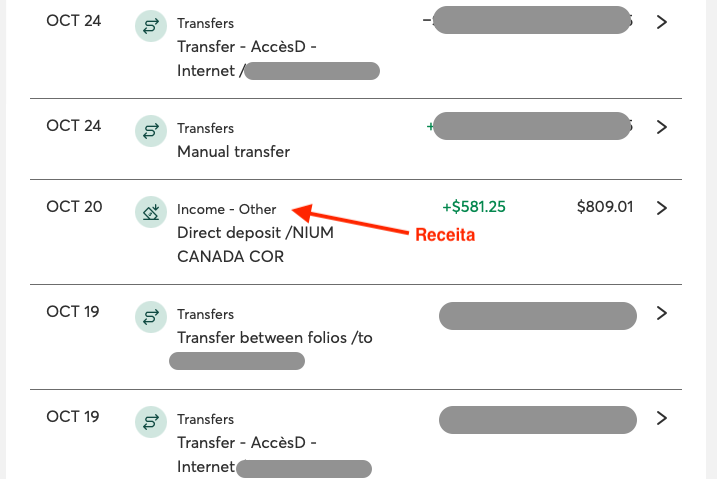
View of a bank statement showing how transactions sending money through WISE platforms are identified on your bank statement in Canada. (May vary from bank to bank)
In Brazil, the Central Bank recently began monitoring amounts and movement limits with the aim of tracking money laundering activities. In Canada, the level of banking supervision may be more rudimentary compared to Brazil, and movements of relatively low amounts may not be a significant concern for the Revenue. However, oversight policies and procedures may evolve over time, and it is important to be aware of your tax obligations and stay up to date with financial regulations in your country.
What do I mean when I say low values in Canada? When I talk about low incomes in Canada, I am referring to amounts of income that, compared to local standards, can be considered relatively modest. To give some perspective, when I mention high income in Canada, I’m referring to people whose annual salaries significantly exceed 150,000 Canadian dollars.
If you are making a considerable effort to convert your income from reais to Canadian dollars and they do not exceed 3 or 4 thousand dollars per month, it is important to recognize that, in financial terms, you may be considered a small part in a context where higher amounts are the norm.
As I mentioned at the beginning of this article, I would like to point out that I am not an expert on this subject, and this observation is based on empirical observations of the tax system. Furthermore, I am not making any recommendations for tax evasion. Tax compliance is an individual responsibility, and the decision to comply with tax obligations is the sole responsibility of the taxpayer.
5. If I earn income outside of Canada in the same tax year and include it on my tax return, what difference will it make to my refund?
In most cases, this will reduce your refund, but sometimes it can mean you have underpaid tax on your Canadian income after the non-refundable tax credits have been recalculated.
Read also: “10 Frequently Asked Questions about Income Tax Returns in Canada”
6. Should I declare my net or gross income from my country of origin?
Declare your net income. In other words, how much you received in your bank account. You can use your income report, in the case of a formal job, or a spreadsheet where you enter your income and expenses with a rented property, for example. For sources coming from legal entities, consult your accountant.
7. In what situation can I owe money to Canada, even though my income comes from abroad?
Your tax liability in Canada is intrinsically linked to your residency status. As a resident of the country, you may find yourself in a tax debt due to income earned abroad, on which you need to pay taxes, or due to claiming non-refundable withholding tax credits, for which you are not eligible. To understand this in practice, consider the following scenario: you are a remote worker in Brazil, accompanying your spouse who is participating in a study program in Canada. Your spouse has temporary resident status and must remain in Canada for three years. During this period, you have a young child who is a beneficiary of a social program such as Canada Child Benefit (Family Allocation), where the government deposits monthly financial assistance into the mother’s account.
To calculate the value of the benefit, the government needs to know the couple’s income. Therefore, if the couple informs that they depend exclusively on the salary of one of the spouses, even if this salary comes from abroad, it is necessary to declare it. This is because social benefit payments follow a table based on annual income. If, at some point, you received these benefits, but hid your income from abroad, it means that, at some point, the Canadian Revenue Service may request the return of the amount paid in benefits, with additional fines and corrections.
8. I received a Notice of Reassessment for a balance due because more income was reported but not substantiated on the T4. What should I do?
If the income reported on the Notice of Reassessment is different from what you received from your employer, you must contact the employer to issue an amended T4 with the correct income and then contact the tax office if there was an error on the Notice of Reassessment.
If the reassessment is correct, the change cannot be filed and you must pay the balance due to the tax office.
If you find the task too complex to handle on your own, it is advisable to seek the assistance of a qualified professional who can represent you before the Canada Revenue Agency (CRA). An important tip is to keep a sworn translation of your annual income statement or any other necessary documents, as you will need to present them in French or English. This is because Canadian tax authorities are not required to review supporting documents in other languages.
My wife follows this procedure every year since she works remotely from Brazil.
Final considerations
There is not much to add other than to express our regret. The “lion of the north” is as ruthless as our fiscal lion in Brazil, and trying to avoid its trajectory can be extremely risky. Carefully consider the legal alternatives available to you to minimize your tax burden in Canada.
Any deviation from this route could have serious implications for your plans to become a permanent resident or citizen in the future. Remember that tax irregularities can be considered a crime in Canada.
Read also: “What changes for you with permanent residence in Canada”
With this, I conclude my observations for today. Remember to subscribe to our newsletter to receive weekly updates on how to prepare for this journey we affectionately call immigration.
See you in the next post! 😀

Marco Vasconcelos
Brazilian, webmaster, and e-commerce specialist living in Montreal since 2018. Founder of Você no Quebec, sharing practical guides, housing tips, and real-life experiences in the province to help Brazilian and international newcomers transition smoothly.
Read more about Marco →