How to use public transit in Montreal
Who manages public transit in Montreal?
When living in Montreal, there is a very high chance you will use transit services managed by the STM at some point—whether commuting to work, going to school, or exploring the city’s neighborhoods, nightlife, and parks.
For those who don’t know, the Société de transport de Montréal (STM) is the public transit agency responsible for operating bus and metro lines across the island of Montreal, working in coordination with Exo (commuter trains), the Société de transport de Laval (STL), and the Réseau de transport de Longueuil (RTL).
Why use public transit in Montreal?
Montreal has one of the most comprehensive public transit systems in North America, serving its 4.5 million metropolitan residents. Its metro network, one of Canada’s oldest, is known for its speed and ease of use. Where the metro does not reach (mostly the far eastern and western zones of the island), buses and commuter trains cover the rest.
Read also: “Montreal Neighborhoods: Discover the 4 main regions of the island and their contrasts”
Public transit is clean, efficient, and very well laid out. While you might occasionally encounter typical big-city eccentricities, the network performs its role exceptionally well, especially when traveling to the city center or going out at night.
The infrastructure of the stations (especially the newer or renovated ones) is impressive. Compared to other major Canadian cities like Toronto and Vancouver, Montreal’s system stands out for its high coverage density.
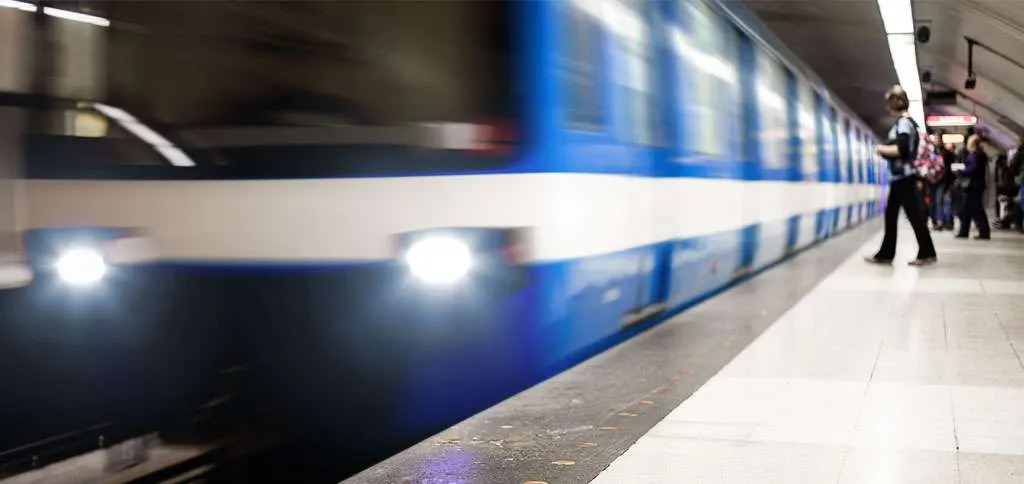
Montreal Metro station - Source: Stock image
Punctuality of Montreal transit
Public transit here runs on a strict schedule. While winter snowstorms or freezing rain can cause temporary delays, the system remains highly punctual for most of the year.
Read also: “Is Canada better prepared for extreme cold than the US?”
Depending on where you are coming from and where you are going, the metro can be two to three times faster than the same trip by car. Believe me when I say that downtown traffic here gets genuinely chaotic at certain hours.
Coming from Brazil, this is one of the adjustments that takes the least effort. Delays happen, but we are talking a few minutes, not the kind of wait that reorganizes your day.
Accessibility
Since the Montreal Metro network opened in 1966, accessibility was not a primary design standard initially. Consequently, you will find that several older stations still lack elevators.
The city has been retrofitting stations with elevators steadily. If you have mobility needs, it is highly recommended to check the STM’s accessibility map beforehand. On the other hand, the bus fleet is fully accessible, featuring low-floor entry and hydraulic kneeling systems to align with curbs.
Transit etiquette and habits in Montreal
- Winter and timing: Because buses run on time, residents rarely wait at outdoor bus stops during freezing winter days until just a few minutes before the bus is scheduled to arrive. Nobody has any interest in turning into a penguin for free on a -20°C day, so checking transit apps beforehand is standard practice. And for reasons I still do not understand after years here, bus shelters are not heated and have an open gap along the bottom that does absolutely nothing to keep the wind out.
- Queuing: When boarding buses, passengers form orderly lines at the stops, and respecting this order is an unwritten rule.
- Noise and behavior: Speaking loudly on phones or playing audio out loud is considered discourteous. Passengers always use headphones. It is also customary to remove backpacks and place them on the floor between your legs to make space for others.
- Winter slush: During winter, melting snow and road salt are carried onto buses and trains on boots. The heating systems melt the slush, meaning floors will often be wet and muddy.
- Winter clothing: Heavy winter parkas rated for -20°C to -40°C can feel like saunas once you step inside heated buses or metro cars. Wearing layers that you can easily unzip or adjust is recommended.
- Strollers and carts: It is very common to see passengers boarding with strollers, grocery carts, or luggage. Buses and trains feature designated areas with foldable seats to accommodate them.
Public transit vs. driving a car in Montreal
If you plan to drive in Canada, you will need to get your driver’s license and buy a vehicle, which may not be realistic for someone who is just starting out here. While you wait to sort that out, transit is what gets you around.
When I arrived in Quebec it took me a good five months before I even started thinking about buying a car, even though I had budgeted for one back in Brazil. The complicating factor was that we landed at the start of winter, and that is precisely when it becomes hard to get around to see used car sellers and dealerships that sit outside bus routes, in the industrial zones where most of them are.
If you are going to live further from downtown in the east or west ends, or in suburbs like Laval, Longueuil, Brossard or Nuns’ Island, do the honest math: combine your bus-to-metro commute time with the real cost of owning a car before deciding it is worth it.
Read also: “How to get your driver’s license in Quebec: Complete Guide”
For those living off the island of Montreal, regional transit passes are more expensive. However, commuting by car to downtown Montreal daily can incur high parking and fuel costs, meaning public transit is still the most popular commuting option.
Read also: “How to buy a new or used car in Canada in 10 steps”
 Important Tip! Important Tip!To live without a car, renting an apartment within walking distance of a metro station is ideal. Keep in mind that rent prices near metro stations are typically higher due to the high demand. |
Modes of public transit in Montreal
Montreal’s integrated transit network includes the metro, extensive bus lines, light rail, commuter trains, and specialized taxibus services:
1. The Metro
The metro network consists of four lines identified by color:
- The Orange Line: Runs in an L-shape connecting Saint-Laurent, downtown, and Laval.
- The Green Line: Connects Angrignon in the southwest to Honoré-Beaugrand in the east.
- The Blue Line: Runs across the north-central part of the island from Snowdon to Saint-Michel.
- The Yellow Line: Connects Berri-UQAM to Longueuil on the South Shore.
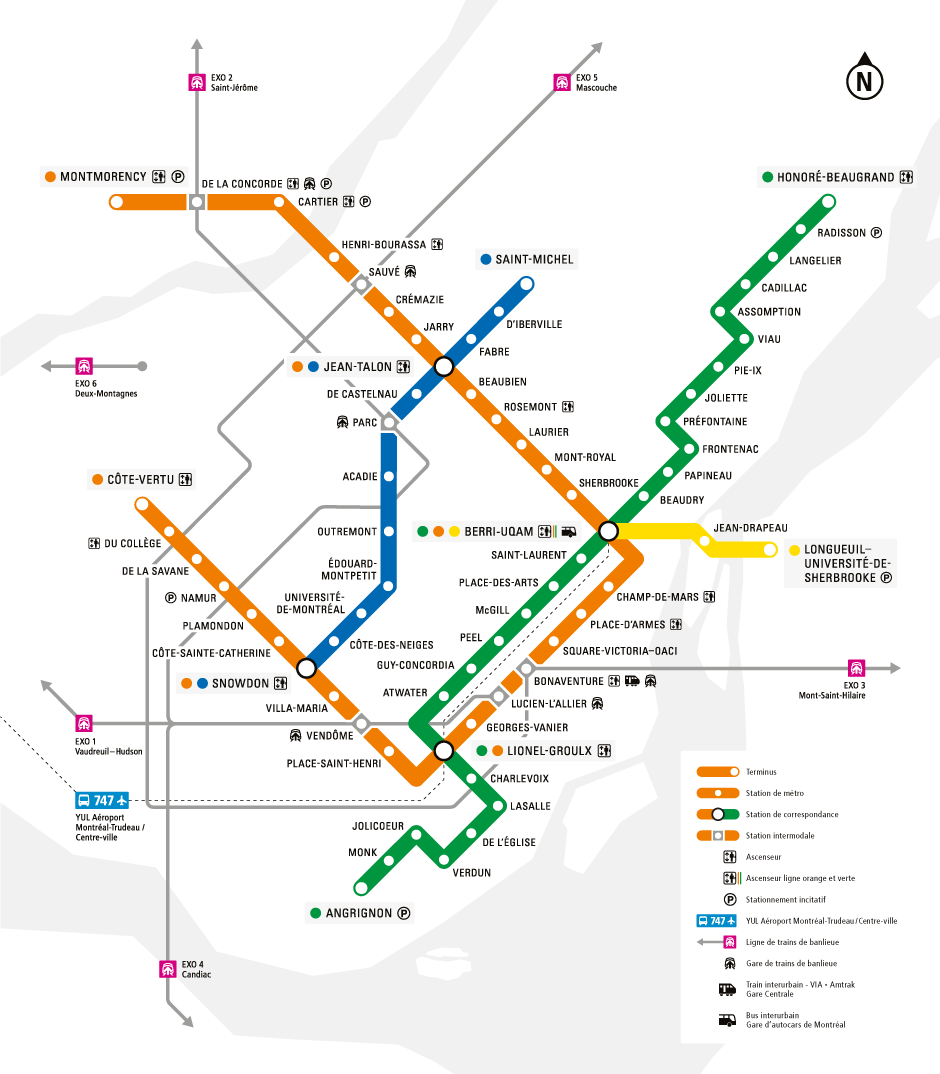
Montreal Metro Map - Source: STM
| Important Tip! Bicycles are welcome on the metro during designated non-rush hours on weekdays and all day on weekends. Be prepared to carry your bike up stairs, as not all stations have elevators. Check the rules here. |
2. Réseau express métropolitain (REM)
The REM is Montreal’s automated light rail network, and it has grown considerably since it first opened:
- Rive-Sud branch (Brossard): in service since July 2023, the first segment to open.
- Deux-Montagnes branch: entered service on November 17, 2025.
- Anse-à-l’Orme branch (West Island): opened on May 18, 2026, with four stations — Des Sources, Fairview–Pointe-Claire, Kirkland and Anse-à-l’Orme.
- Airport branch (YUL): still under construction, scheduled to open in spring 2027. It will add the Marie-Curie and YUL-Aéroport-Montréal-Trudeau stations.
So as of 2026 the REM already covers the South Shore, the north (Deux-Montagnes) and the West Island. The only missing link is the airport connection — which happens to be the one that matters most if you are landing in Canada for the first time.
3. Buses
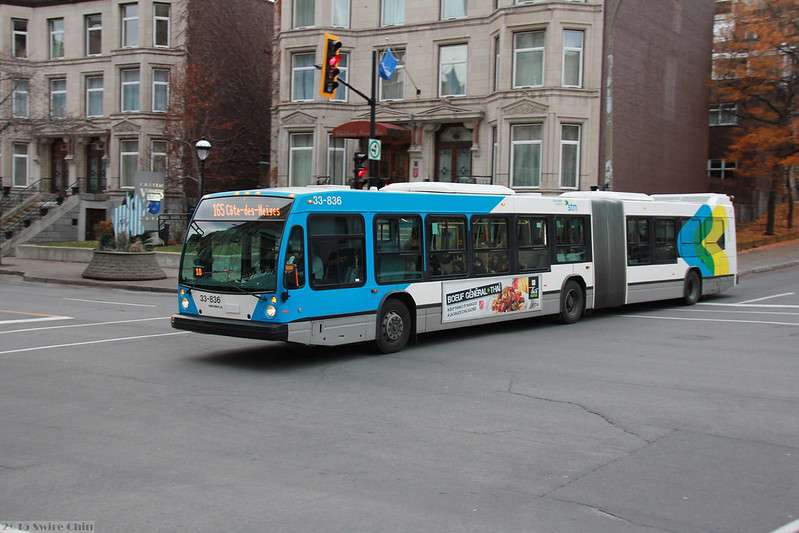
Buses cover the entire island and operate 24 hours a day, with late-night routes running after the metro closes (which happens around 12:30 AM to 1:00 AM). Express bus routes offer faster transit with fewer stops. You can pay using a reloadable OPUS card or exact change in coins.
4. Exo Commuter Trains
Exo operates commuter train lines connecting downtown Montreal to suburban outer rings, including Vaudreuil-Hudson, Saint-Jérôme, Mont-Saint-Hilaire, and Candiac.
5. Taxibus
Taxibus is a on-demand shared taxi service for rural or low-density routes not regularly served by standard bus lines. You must book your ride 40 to 60 minutes in advance, and fares are paid using your OPUS card (no cash accepted).
6. River Shuttles (Navettes Fluviales)
During the summer (typically June to September), ferry shuttles operate between the Old Port of Montreal, Parc Jean-Drapeau, Longueuil, Boucherville, and Pointe-aux-Trembles. They offer a scenic 30-minute crossing on the Saint Lawrence River. Fares cost $5.50 CAD per crossing or are included in regional “All Modes” transit passes.
Planning your routes: Maps and tools
Transit Maps
Route Planners
Use the STM Trip Planner or Exo Trip Planner. For mobile navigation, Google Maps works well, but the Transit App is highly recommended for tracking buses and trains in real-time.
Transit fares and how to pay
Fares
A single ticket for travel within Zone A (island of Montreal) costs $3.75 CAD — this fare was held steady in the July 2026 adjustment.
Monthly passes were re-indexed on July 1, 2026, with an average 3% increase across the metropolitan region. Current prices:
- Zone A (island of Montreal): $110.00 CAD per month
- Zone AB (Montreal, Laval and Longueuil): $170.00 CAD per month
- Zone ABC (includes the north and south crowns): $206.00 CAD per month
Discounts are available for multi-trip cards and 3-day passes, and reduced rates apply to students and seniors.
Heads-up: fares in this article were reviewed in August 2026 and reflect the grid that took effect on July 1, 2026. Since fares are normally adjusted every July 1, always check the official ARTM fare page before buying.
Buying tickets
Tickets and passes can be purchased at metro station kiosks or ticket machines using credit or debit cards.
| Important Tip! A single transit ticket includes free transfers between buses and the metro for up to 120 minutes from the time of purchase, provided you stay within the same zone. |
The OPUS Card
The most common way to pay is using the OPUS card.
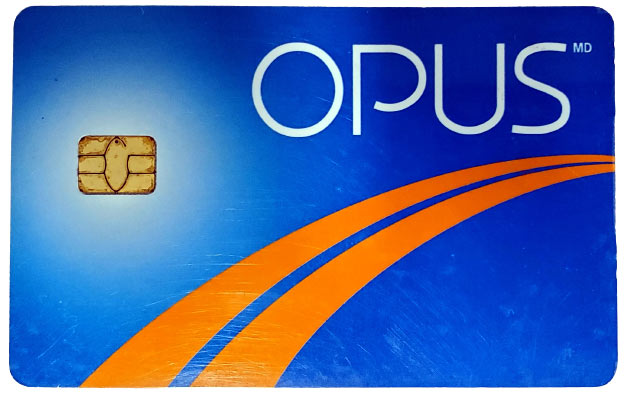
OPUS Card - Source: Personal Archives
A reloadable plastic OPUS card costs $6.00 CAD and can be loaded with tickets or monthly passes. It is highly recommended to register your card online so that your remaining balance can be recovered if it is lost or stolen. You can also view your card balance on your smartphone using the official SAAQ/STM card reader apps.
| Important Tip! You can also purchase and reload OPUS cards at participating pharmacies like Jean Coutu, which is very convenient if you are far from a metro station. |
Student Fares
Students enrolled full-time in registered institutions can obtain a Photo OPUS card, which grants heavily discounted fares. To get one, bring a school-attested application form, a photo ID, and the fee ($15 CAD in cash) to an STM photo studio or apply online via your student portal.
Car sharing and bike sharing in Montreal
Communauto
Quebec is a pioneer in car sharing. Through Communauto, you can rent vehicles by the minute or hour. You can link your Communauto account to your OPUS card, allowing you to unlock cars using your transit card.
BIXI Bike
Montreal features over 800 km of bike paths and a popular bike-share network called BIXI. Stations are spread throughout the city. Fares range from $2.99 CAD for a single ride to annual memberships for $97.00 CAD (fees apply to classic bikes; electric BIXIs carry additional surcharges). The service operates from April to November.
With this guide, you are fully prepared to navigate Montreal like a local. To receive more practical tips about settling in Quebec, subscribe to our newsletter.
Safe travels and see you in the next post! 😉

Marco Vasconcelos
Brazilian, webmaster, and e-commerce specialist living in Montreal since 2018. Founder of Você no Quebec, sharing practical guides, housing tips, and real-life experiences in the province to help Brazilian and international newcomers transition smoothly.
Read more about Marco →