
6 Steps to Choose Your Child's High School in Quebec
| Update note (August 2026): the selection process and the six steps described here remain valid, that's what rarely changes. What changes every year are the school rankings and the application deadlines. The comparative notes cited in the text serve as an example of methodology, not as a current classification. Before deciding, consult the most recent ranking of the Institut Fraser and, especially, the admissions calendar of the centre de services scolaire in your region, the deadlines for selective programs usually close between September and November of the year before the input. |
Before choosing a school, abandon some myths
Choosing our daughters’ high school was one of the most difficult decisions of moving to Quebec. Not because of a lack of options, but because age, command of French, neighborhood, educational program and registration deadline end up intersecting at the same time.
In your planning, three factors weigh heavily: the student’s age, prior knowledge of the language and the city or neighborhood where the family will live.
Here I share what my wife and I learned in practice, including the mistakes we made and the expectations that needed to be revised.
In 2018, we moved to Quebec with our twin daughters, who were 13 at the time. In Brazil, they took extracurricular language classes, one hour a week for a year for French and two years for English. I can say that this joint effort helped a lot with the transition, but it was still not enough for them to enter directly into a regular French class in Quebec.
When we arrived in Canada, we expected to find a perfect school environment and the belief that the children would adapt quickly to everything. I’m mistaken!
Before presenting the 6 steps to choosing your child’s secondary school in Quebec, it is important to address the myths about education in Canada, with a special focus on Quebec.
Myth 1: Brazilian mutt complex
We had a great illusion about what schools abroad would be like and, when faced with reality in our first year, we even considered the possibility of returning to Brazil. After all, our primary motivation in coming to Canada was to provide an education that would truly shape our daughters’ future.
It cannot be denied that the educational system in Canada is ahead of Brazil in some aspects, but that does not necessarily make it superior. It all comes down to a matter of perspective. You will understand this quickly after educating your children here.
Read also: “Brazilian mongrel complex: how it affects adaptation abroad”
Myth 2: Children always adapt quickly
It is also necessary to demystify the idea that children learn quickly and adapt easily to new situations, such as moving to another country. This belief may even be valid for children between the ages of 4 and 11, who are starting their primary education, but when it comes to pre-teens or young adults, the issue can be much more complex.
So, the earlier the better. I’m not saying that it’s impossible to be successful with older children (over 15-16 years old), but the Canadian education system’s own statistics show that the challenge is considerably greater for immigrants.
Myth 3: Every public school in Canada offers quality educationYes, all public schools in Canada “should” offer the same teaching conditions, but this does not always happen. The program follows a rigorous standard and teachers must have quality training, however the reality of education in the country has undergone significant changes over the last 5 years due to the exhaustion of the capacity to accommodate so many people arriving in such a short time.
Read also: “Report reveals impact of Temporary Immigrants in Quebec”
Furthermore, the decentralization of the education budget in Canada allows cities and even neighborhoods to invest more resources in education compared to their peers. In short, the quality of life in Canada is directly linked to the amount of resources that your district’s school committee allocates to education. And living well in this country has never been as expensive as it is now.
Now I’ve exposed some of the main myths, let’s go to the 6 Steps to Choosing Your Child’s Secondary School in Quebec!
##1. Understand the Quebecois Educational System
The educational system in Quebec is recognized for its diversity and decentralized management. Before you begin exploring secondary school options, it is important to have a basic understanding of the Quebec education system.
Secondary education calendar in Quebec
The secondary education calendar in Quebec follows a pattern common to many regions, with the school year generally divided into three sessions (fall, winter and spring). Each session comprises approximately 18 weeks of classes, with a break of about a week during the spring, known as “Semaine de relâche scolaire” or “Spring break” for algophones.
Read also: “How to prepare for spring in Quebec: Your Complete Guide”
- Fall Session: From mid-August to December 22nd. (Start of school year)
- Winter Session: January 5th to 7th until mid-March.
- Spring Session**: Mid-March to June. (End of school year)
In addition, there is a short break at the end of the autumn session, usually during the Christmas and New Year period (about two weeks), as well as an extended vacation at the end of the school year, which usually occurs during the summer, between June and August. During the summer, some schools may offer additional education programs or remedial courses for students.
 Tip! Tip!Parents arriving in Canada with school-age children should consider moving between June and July when possible, leaving enough time for enrollment. If that timing is not realistic, children can still enroll during the school year, subject to available places. Starting early improves your chances of securing a place in sought-after schools and selective programs, whose deadlines may fall months before classes begin. |
It is important to note that the specific school calendar may vary slightly between schools and districts, so exact calendar details can be found on school websites or through direct communications with local education authorities.
Secondary education in Quebec is divided into two cycles
In the first cycle, which lasts two years, students receive common basic training, covering the first and second years (1st and 2nd years of high school).
The second cycle lasts three years, comprising the third, fourth and fifth years (3rd, 4th and 5th years). This cycle offers broader training. During these five years, students acquire knowledge in areas such as languages, mathematics, arts and humanities, as well as general training areas such as health and well-being, guidance and entrepreneurship, environment and consumption, media, coexistence and citizenship.
Just like in primary school, students receive homework and are assessed in the classroom through tests. In their fourth year of high school, they must take the ministerial exams in June, which are standardized across Quebec and cover mathematics, science and history. In the fifth year, the ministerial exams are in French and English. At the end of high school, students receive a high school diploma (DES).
You can also find out a little more about the school system in Quebec in this post: “How does the school system in Quebec work?”
Note! Your child will notice a significant difference in the curriculum when starting secondary education in Canada, as subjects such as mathematics are much more advanced in our country for the same grade level. For parents whose children do not have an affinity for physical activities, there is another surprise: the load of activities is quite demanding compared to Brazil, regardless of whether it is -20ºC outside.
Types of Secondary Schools in Quebec (In French)
There are several secondary school options in Quebec, including public schools, private schools and specialized schools. Public schools are government-funded and accessible to all students, while private schools may charge tuition and offer alternative or religious programs. Specialized schools focus on specific areas, such as arts, sports, science or international studies.
Some schools, in addition to general education, offer primary and secondary education students particular pedagogical content:
- Alternative schools;
- Artistic training (music, dance, theater);
- Sports Studies;
- Dota (gifted students);
- International education. See the website of the Société des écoles du monde du BI du Québec et de la francophonie.
These schools are accessible by selection (interests, aptitudes, report cards or tests). Check with the school services center for a list of these schools.
How Much Does Secondary School Cost in Quebec?
The cost of studying at a secondary school in Quebec can vary depending on several factors, such as whether the school is public or private, whether the student is doing the program alone or is accompanied by a parent with permanent resident or temporary status, among others.
For Canadian citizens and permanent residents of Quebec, secondary education in public schools is free. However, there may be additional fees for school supplies, uniforms, extracurricular activities, or field trips.
- School fee per session: From $150 to $300 CAD* (Payment every 4 months)
- School supplies: You are responsible for the purchase, however, these are supplementary items, such as file folders, pencils, pens and notebooks. All books and teaching materials are provided by the school. If your income is low, you can apply for financial assistance from the government in the amount of $200 to help purchase these materials.
* This value may vary between schools and also between programs, even in public schools. Additionally, external activities such as excursions and tours are generally included in this fee.> Children of temporary residents (holders of a study or work visa) are entitled to government-subsidized education up to the age limit of 17 years (one year less than the rest of Canada).
Read also: “What changes for you with permanent residence in Canada”
On the other hand, private schoolss generally have tuition for all students, regardless of residency status. Tuition fees at private schools can vary considerably depending on the school’s reputation, location, facilities and programs offered.
To get an idea of the costs, consult directly the admissions area at Collège Regina Assumpta. The institution is in the neighborhood where I live, but the monthly fee tables change every year and old PDFs no longer represent the current value.
| Tip! The Quebec government allows you to deduct a significant portion of private education costs from your income tax, but even so, this can be a considerable expense for those transitioning from one country. |
Read also: “10 Frequently Asked Questions about Income Tax Returns in Canada”
Ministry Provincial Exams
Students in Quebec are assessed using so-called Ministry tests, which are administered in various subjects, such as mathematics, science and French. These exams play an important role in evaluating students’ academic performance and determining their eligibility for graduation, as well as serving as a basis for evaluating the quality of the educational institution.
By understanding the structure and key aspects of the Quebec education system, parents and students can make more informed decisions when choosing a secondary school that meets their educational needs and goals.
It’s important to consider factors such as curriculum, school culture, available resources, and extracurricular opportunities when making this choice.
Quebec school commissions
School boards in Quebec play a crucial role in managing and supervising the provincial education system. Each district or neighborhood has one of them and they will be the ones you should talk to to enroll your child in Quebec as soon as you arrive.
Currently, the provincial government is in the process of eliminating special school committees for Anglophone (English-speaking) students, transferring this responsibility to the French language committees. However, this change is still being debated and contested.
Here are some of the main roles they perform, including responsibility for enrolling and distributing students in the immigration process:1. School Administration: School committees are responsible for managing public schools within their geographic jurisdictions. This includes ensuring there are places available for students in the immigration process and facilitating their integration into local schools. 2. Curriculum Development: They collaborate with the Ministry of Education to develop and implement school curricula that meet provincial standards and promote the academic success of students, including those in the immigration process. This involves adapting educational programs to meet the linguistic and cultural needs of newly arrived students. 3. Planning and Resource Allocation: School committees are responsible for developing long-term strategic plans for their schools and communities, ensuring efficient allocation of resources to meet the educational needs of students, including those in the immigration process. 4. Community Participation: They represent the interests of the school community, including parents, students, teachers and members of the community in general. School committees carry out public consultations, involve parents in decision-making and ensure that the needs and concerns of students in the immigration process are considered in educational policies.
In summary, school boards in Quebec play an essential role in promoting educational excellence, representing the interests of the school community and ensuring an inclusive and equitable education for all students, including those in the immigration process.
##2. French secondary school in Quebec
When parents choose to immigrate to Quebec, it is important that they are aware that this Canadian province is the only one in the country where French is the official language, contrary to the pseudo “bilingualism” promoted by the federal government in its propaganda.
Read also: “5 major cultural differences between Quebec and other provinces in Canada”
A crucial aspect when choosing a secondary school in Quebec is deciding whether your child will study in English or French. Here are some points to consider when making this decision:
Previous contact with the language and proficiency
Be realistic about your child’s proficiency level. If he did not have effective exposure to the French language during elementary school, it is likely that the adaptation process will be faster if he chooses to study in English, as the grammar of this language is less complex than that of French.
Furthermore, as English has been integrated into our Brazilian culture for many years, through the media and the internet, it is likely that your child is already familiar with the language, even if they only had the minimum number of language hours at school.
Parents’ project (permanent or just transition)
If parents are passing through Canada for professional or study reasons and have no intention of staying, it only makes sense for their child to study in French if they already have command of the language, as the transition to a curriculum in French requires a very high level of proficiency to follow the classes.
Some schools may require students to demonstrate a certain level of proficiency in French before being admitted to the regular program, requiring the student to attend so-called reception or transition classes (classe d’accueil) for up to 2 years.
Reception or transition class in Quebec (class d’accueil)
Establishing yourself in a new country brings with it great challenges. To facilitate learning French and integration into Quebec, children from allophone families (who do not have French as their first language) are sent to reception classes. In these classes, children receive support to learn French and understand the codes and values of their new adopted society. Welcome classes are predominantly found in the greater Montreal region, making it the main destination for newcomers (with Sherbrooke being the second most common region).
Upon arrival, some students are directed to these classes, where they interact with others of different origins and ages, in a variable transition period for each one (generally around ten months to 2 years depending on development).
Read also: “Francisation in Quebec: 7 truths that no one tells you about this program”
Schools organize students into host classes based on the number of allophone students, their level of French, age and availability of educational resources.
In some institutions, allophone children are integrated directly into regular classes, receiving support to learn French. This direct immersion into the conventional classroom is becoming increasingly popular around the world.
Teachers in host classes assess students’ French skills and, if necessary, create subgroups, such as beginners and advanced. They use a variety of educational methods to facilitate learning French, such as gestures, images, music, theatrical expressions, everyday vocabulary, translation applications, reading plurilingual albums, playful activities and valuing students’ mother tongues to enrich their learning, among others.
How long can my child attend a Reception class?
Each child has individual skills in learning a new language. It’s common to feel like progress is slow, especially in the first few months. However, it is possible to see significant progress after a few months of learning.
The duration of reception classes may vary according to the student’s individual needs and characteristics, as well as their progress in learning the language. Therefore, there is no fixed minimum or maximum duration. Generally, students attend reception classes for around ten months, but have the right to use the service for as long as necessary for their adaptation.
Age limit for entering secondary school in Quebec
For this topic, I will detail it in the following video.
Video recorded in December 2022 on TikTok with the title: “What no one says about immigrating to Quebec with teenage children”
What criteria are considered for the transition to the regular class?
After completing their period in the host class, students are integrated into a regular class at the level corresponding to their age. Using an assessment scale based on learning levels, the teacher determines whether the student has reached the minimum level associated with their age, even if they have not completed the usual ten months in the host class.
Naturally, to meet the individual needs of some students, it may be the case that a student is integrated at a lower level, although this is quite uncommon. It is also possible to keep the student in the reception class for an additional period, depending on their needs.
There is no established deadline during the school year for the transition of students from the reception class to the regular class. However, it is preferable to wait for the end of a school cycle and the issuance of a bulletin or communication before moving students to another class or school.
##3. English secondary school in Quebec
Now that you are more informed about the scenario and implications of enrolling your child in a Quebec secondary school (in French), let’s discuss plan B, which is becoming increasingly common among parents with special circumstances.
However, it is important to highlight that it is not enough to just want your child to study against French in a province that is increasingly engaged in a battle against the use of the English language.
Requirements to study in English in the province of QuebecIn order for your child to study at an English secondary school in Quebec, there are some requirements and considerations to be observed:
- Quebec Residency: Your child must reside in the province of Quebec to be eligible to attend an English secondary school.
- Language Eligibility: Generally, English secondary schools in Quebec are designed for students whose mother tongue or primary language of instruction is English. However, there are some exceptions for students who demonstrate an exceptional need to attend an English-medium school.
- Documentation and Proof of Eligibility: You may be asked to provide documentation proving your child’s linguistic eligibility to attend an English-medium secondary school. This may include documents such as a birth certificate, proof of residence and educational transcripts.
- Application Process: The application process may vary by school and school district. Typically, you will need to complete an application form and provide the necessary documentation. It is important to contact the specific school or school district for accurate information about the application process.
- Possible School Fees: Depending on the type of school (public or private), there may be school fees associated with enrolling in an English secondary school in Quebec. Make sure you check the costs involved before signing up.
The list of criteria is extensive; I recommend accessing the official website of the Quebec Ministry of Education for updated and complete information. This prevents me from including outdated information in this post.
| Tip! significantly lower compared to the French school network. |
It is recommended that you contact the school or school district directly for accurate, up-to-date guidance on the application process and eligibility requirements.
##4. Consider the School Location
I would highlight that the location of the school plays one of the most significant roles in your child’s educational experience and daily life. Surprisingly, this doesn’t differ much from Brazil, although I initially assumed it would be different in Canada.
As mentioned previously, living well in Canada is closely linked to proximity to excellent schools. This relationship is so obvious that you will soon realize that the best neighborhoods generally offer the best educational infrastructure resources.
It is also worth noting that you are not the one who determines exactly which school your child will attend in Quebec; This is one of the responsibilities of each district’s school committees.
If you anticipate your child’s enrollment process early enough, you may be able to direct them to a school of your choice, but this is not guaranteed. Factors such as proximity and availability of vacancies have a significant impact on this process.
Read also: “Neighborhoods of Montreal: Discover the 4 regions of this island and their contrasts”
Here are some important aspects to consider when evaluating a school’s location:
Proximity to Residence:* Ease of Access: Choosing a school that is located close to your home can facilitate access and reduce daily travel time. This can be especially important for families with younger children or those who rely on public transportation.
- Stress Reduction: A nearby school will reduce stress related to daily transportation, allowing your child to get to school faster and more efficiently.
Access to Extracurricular Activities:
- Participation in Activities: A school located close to home may allow your child to more easily participate in extracurricular activities before or after school. This is especially beneficial if your child is interested in sports, clubs, or other activities offered by the school.
- Less Travel Time: A nearby school will reduce travel time between school and extracurricular activities, allowing your child to make the most of their free time.
Local Community:
- Community Integration: Choosing a school located in your community can promote greater social integration and connection with classmates who live in the same area.
- Parental Participation: A nearby school can facilitate parental participation in school events, parent meetings and other activities that promote parental involvement in their children’s education.
Transport Options:
- Public Transport: Check whether the school is located near bus stops, metro stations or other public transport options. This is important if your child needs to use public transport to get to school.
- Cycling or Walking Routes: Consider whether the school is located in an area that offers safe cycling or walking routes, allowing your child to choose more sustainable and healthy modes of transportation.
- Free Transportation (Yellow Buses): Secondary school students who are more than 2 km from their designated school are entitled to public transportation in Quebec. Find out more by clicking this link.
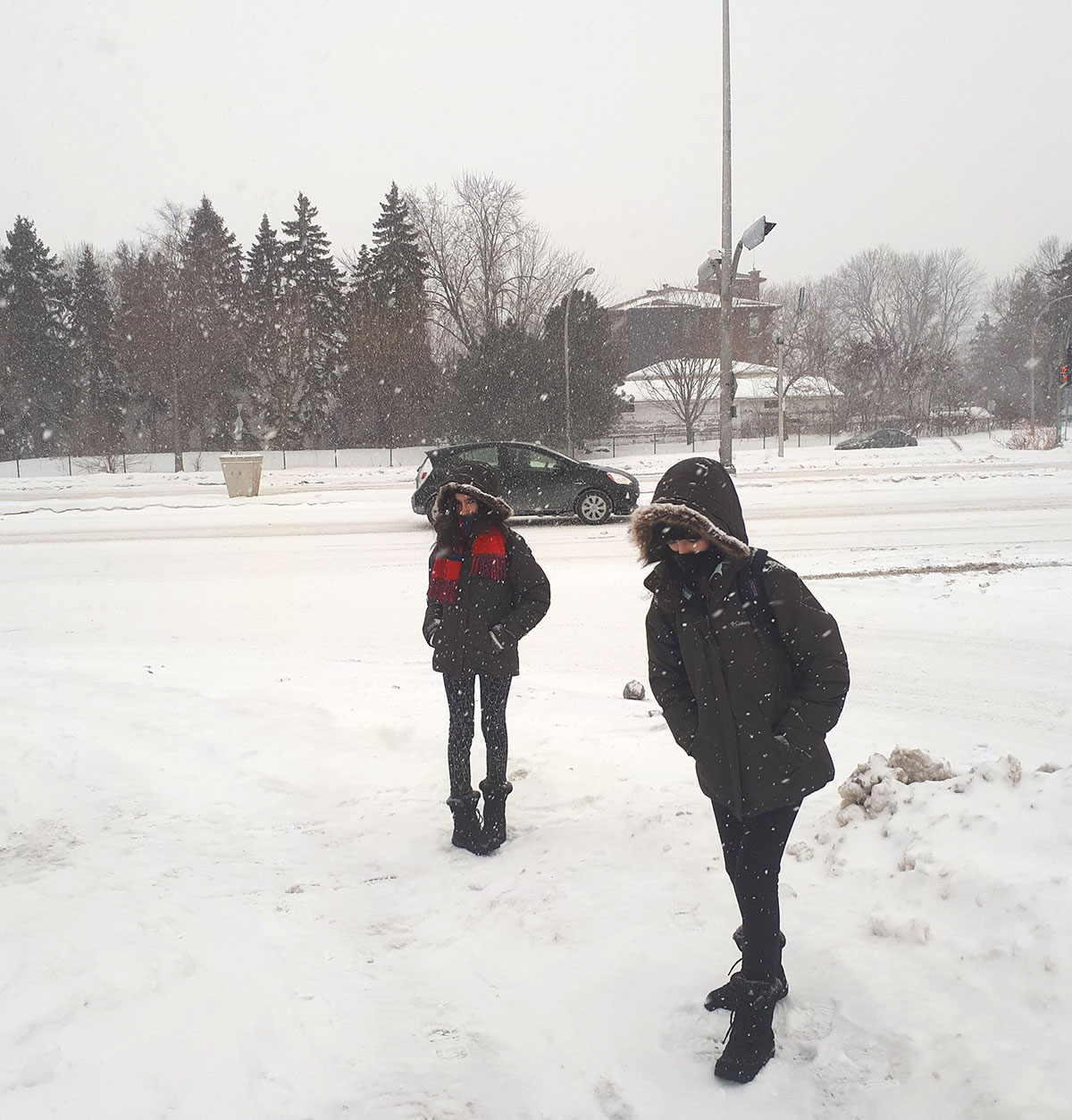
First week of school in Laval, Quebec (January 2019)
At 13 years old, they had to walk approximately 2 kilometers to get to school, even during snowfall. We were informed by the school that, for technical reasons, the residents of our condominium did not have access to the school bus at the door.
Security and Local Environment:
- Safety: Assess the safety of the area where the school is located, including crime rates, street lighting, and the presence of safe pedestrian crossings.
- General Environment: Consider the general environment of the area surrounding the school, including parks, shops, restaurants and other amenities that can contribute to your family’s quality of life.
Read also: “Montreal Neighborhoods: Guia Ahuntsic-Cartierville”
##5. Evaluate Academic Performance:
Assessing the academic performance of schools is essential to making an informed decision about which institution offers the best education for your child. However, as mentioned previously, even if you have a specific institution in mind, there are no guarantees that it will be your first choice.
To minimize this obstacle, school committees can suggest some options based on your needs, such as the availability of reception classes, as not all schools in Quebec offer this service.
Assessment criteria for schools in Quebec* Reflection of School Efficiency: Schools with high graduation rates generally indicate a positive and supportive learning environment where students are more likely to stay and complete their studies.
- Performance Standard: Provincial exam results can offer insights into student performance in key areas of study such as mathematics, science and languages.
- Performance Comparison: Comparing the school’s student results on provincial exams to the provincial average can help determine how effectively the school is preparing its students for these standardized assessments.
- Participation in Advanced Programs: Schools that offer advanced programs, such as college-level or AP courses, may indicate a commitment to academic excellence and enrichment opportunities.
- Support for Students with Special Needs: Assessing how the school supports students with special needs or different learning requirements can be crucial for families with children in these circumstances.
- Efficiency in the Use of Resources: Understanding how the school uses its financial resources, such as public financing or tuition fees, in relation to academic performance can be important to evaluate the return on educational investment.
How to check these criteria quickly?
Due to the efforts of independent research institutions in Canada, such as the renowned Fraser Institute, it is possible to access relevant information about the performance of schools in the country.
To this end, they regularly publish reports on education levels in the provinces, as well as providing an interactive online tool to access the results.
You can use this link to search for schools in Quebec.
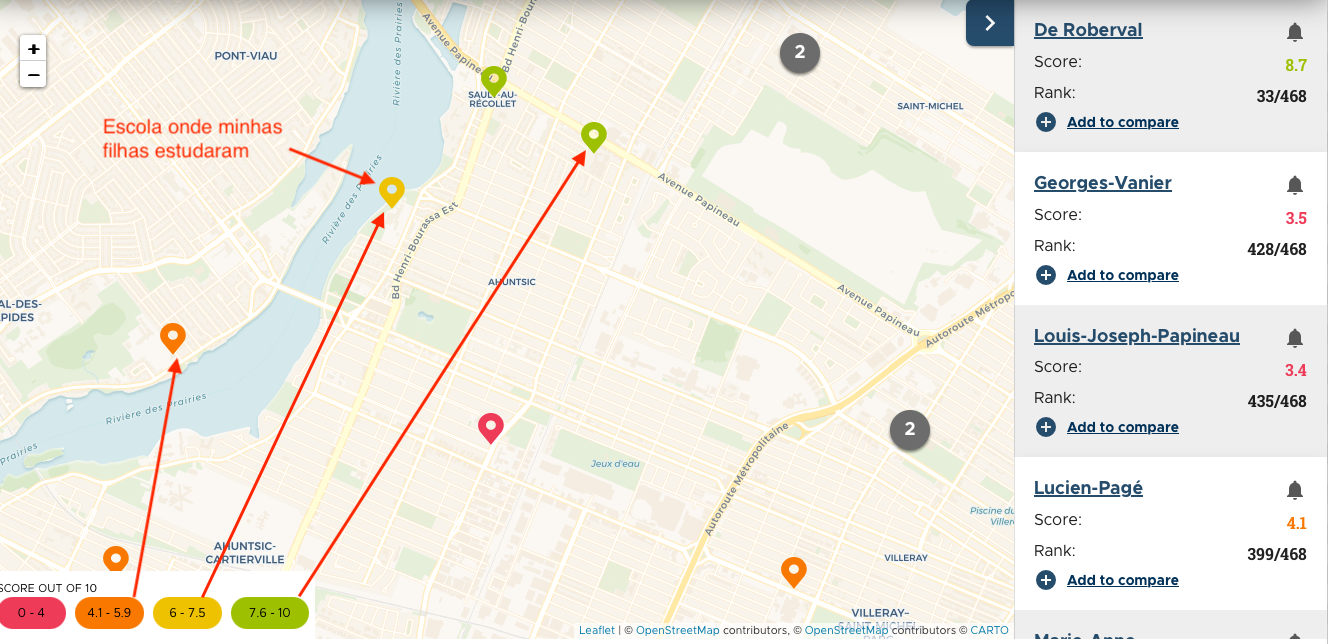
Map of schools in Quebec - Source: Fraser Institute
Note that the tool classifies schools into 4 score bands. I myself was able to prove this reality in practice when I transferred my daughters from a not so well ranked school in Laval (École Saint-Maxime) to a better one, as soon as we moved to Montreal (École Sophie-Barat). The leap in quality, even with a relatively small points difference, was absurd
Read also: “Montreal Neighborhoods: Guia Ahuntsic-Cartierville”
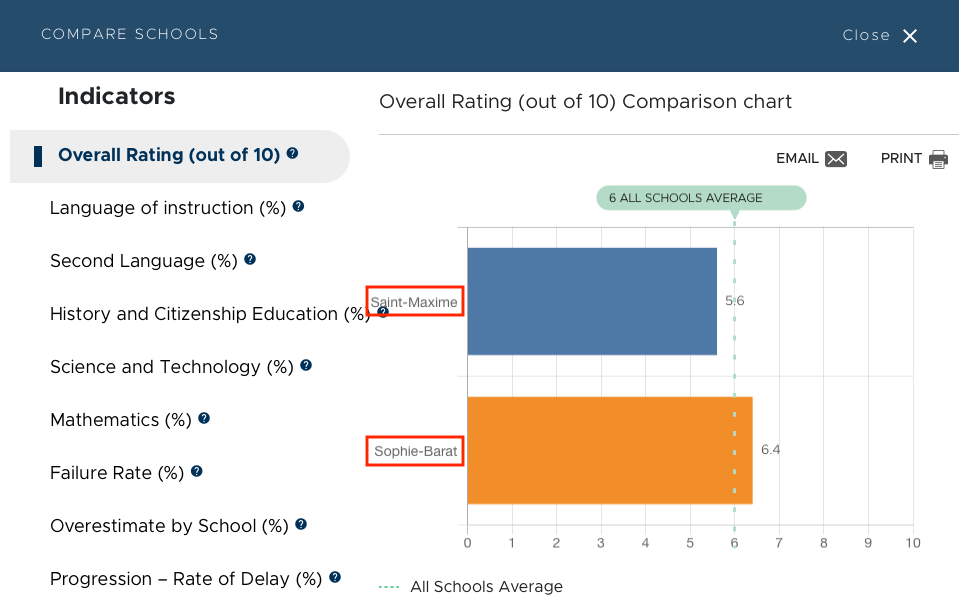
Comparative Quebec Schools - Source: Fraser Institute
Another thing you will notice in the ranking is that, mostly, all private schools are among the best. This is fundamentally due to the resources offered to students, such as extracurricular activities, better infrastructure and security. Everything, of course, comes with a price.
However, don’t be seduced by this: public schools in the orange band (score of 6 to 7.5) can easily be on par with private schools in Quebec, as long as your child has access to the advanced programs offered by some of them.
One of my daughters attended one of these programs at École Sophie-Barat, called DEFI program (or challenge). To enter this program, students must have an overall average of 85% and above and have results above 80% in each of the basic subjects (French, Mathematics, English and Science).
Bonus! 10 fastest improving high schools in Quebec (fastest at the top)
| School | Location | Score in 2016 | Score in 2022 |
|---|---|---|---|
| Sieur-de-Coulonge | Fort-Coulonge | 2.4 | 5.1 |
| Fernand-Lefebvre | Sorel-Tracy | 2.2 | 5.2 |
| Jeanne-Normandin | Montréal | 3.8 | 7.0 |
| Bon-Pasteur | L’Islet | 2.3 | 4.1 |
| Père-Marquette | Montréal | 3.4 | 5.7 |
| Casavant | Saint-Hyacinthe | 3.3 | 5.4 |
| de L’Érablière | Gatineau | 4.6 | 6.8 |
| Hormisdas-Gamelin | Gatineau | 4.7 | 6.3 |
| Augustin-Norbert-Morin | Sainte-Adèle | 5.4 | 7.2 |
| de L’Érablière | Saint-Félix-de-Valois | 4.4 | 6.4 |
Source: Fraser Institute
You can access the full report by clicking on this link (only available in French)
##6. Analyze Available Resources
Assessing the resources available at a school is essential to ensure it can provide a rich and complete educational experience for your child.
Even in public schools in Canada, the level of investment used in infrastructure and teaching materials is something that leaves our public schools in Brazil in the dust.
Investment in Public Education in Brazil vs. CanadaAccording to a report by the Fraser Institute published in 2019, the Quebec government spent approximately $10,992 CAD (R$40.8 thousand) per student enrolled in secondary education. Although this value is considered one of the lowest among Canadian provinces, it is still much higher than Brazilian investment in public basic education.
According to OECD reports, Brazil invested only US$3,583 (around R$17.6 thousand) per student in basic education in 2020. This represents less than 50% of the amount invested per student in Québec and other developed member countries and yet, the performance of our public school students is disappointing when compared to the general average in Canada.
Now, stop and reflect for a moment: can we really compare the level of investment in public education in Brazil with that in Canada? This, in fact, was the central reason that led me to choose Canada as a destination, where education is still one of the most outstanding aspects of the country.
Here is a list of topics that you should consider when choosing a school in terms of resources offered
- Science Laboratories: Check whether the school has well-equipped laboratories for subjects such as biology, chemistry and physics. Well-equipped science laboratories are essential for carrying out practical experiments and developing scientific skills.
- Educational Technology: Assess the availability of educational technology such as computers, tablets, educational software, and high-speed Internet access. Effective integration of technology can improve teaching and learning, preparing students for the challenges of the modern world.
- School Library: Visit the school library to check the variety and quality of resources available, including books, periodicals, online resources and study spaces. A well-stocked library is essential for promoting reading, independent research, and the development of critical thinking skills.
- Gymnasium and Sports Fields: Check whether the school has adequate sports facilities, such as gymnasiums, sports fields, running tracks and sports courts. Opportunities to participate in sporting activities not only promote physical health, but also encourage teamwork, leadership and social skills.
- Tutoring and Support Programs: Assess whether the school offers tutoring programs, tutoring classes, or individualized support for students who need additional assistance. These programs can help students overcome academic difficulties and reach their full potential.
- Guidance and Counseling: Check to see if the school offers guidance and counseling services to assist students with academic, vocational, and personal issues. Qualified counselors can help students set educational and career goals and provide emotional and social support.
- Clubs and Activities: Evaluate the variety of clubs, sports teams, interest groups and extracurricular activities offered by the school. These activities provide additional opportunities for students to explore their interests, develop skills, and build friendships.
- Cultural and Artistic Events: Check whether the school promotes cultural, artistic and community events, such as theatrical performances, art exhibitions, concerts and cultural fairs. Participating in these events can enrich students’ educational experience by promoting an appreciation of art and cultural diversity.
Opportunities beyond the classroom that my daughters had
My daughters’ school had a water activities center. There, they were able to take a lifeguard course completely free of charge, something that would cost around a thousand dollars in Quebec. This gave them their first work experience, with a technical qualification at the age of 17.
They received training in first aid and even resuscitation. This is important, as only young people with this qualification can work professionally in Montreal’s swimming pools.### Benefits beyond the CV
This opportunity went far beyond the traditional curriculum. My daughters not only developed technical skills, but they also gained confidence, responsibility and a sense of purpose, better preparing them for the workforce.
Final tips for better evaluation of schools
1. Don’t assume that what works for others will also work for you
I learned this lesson from my own experience. I simply enrolled my children in the same school that my friends’ children attended in Canada, thinking it would be the best option. However, I realized that what we want for our children is always a very personal vision.
2. Do your own research
Don’t blindly trust Google reviews or social media. Often times, a school may have a bad rating, but that doesn’t necessarily mean it is a bad option. Keep in mind that most of these reviews come from dissatisfied students.
3. Students also need to do their part
We have a saying in Brazil that says that the school can help with performance, but the student needs to do their part. It is not enough to just choose the school, the student must also make an effort and get involved in the learning process.
4. Start planning for your children’s school in advance
Even without being able to enroll your child, as you will need to be on Canadian soil to do so, you will save a lot of time if you have a definition of housing and schools available in the region. Don’t leave this on the back burner, as places at the best schools fill up quickly.
5. Come with an open mind and see the system as different, but not inefficient
It took me and my wife more than a year to understand that the school does what it does because, in fact, it is better in many aspects than our schools in Brazil. But you need to immerse yourself in the local culture to understand why. The evaluation system and methodology used may surprise you.
6. Consider living in Montreal if you want your child to be bilingual quickly
If one of your goals is to provide a bilingual educational environment, nowhere in Canada does it better than Montreal. Even though the English taught in the classroom as a second language in French-speaking schools is very close to what we see in Brazil, your child will have exposure to both languages much more effectively than in smaller cities in Quebec.
- French-English bilingualism is essential in the Canadian job market: The bilingualism I am referring to here is the command of French and English, languages that are widely demanded in the Canadian job market, especially in Quebec. This linguistic skill is extremely valued.
- Your child will have an advantage because he already speaks Portuguese: The fact that your child already speaks Portuguese puts him in a statistic that is growing a lot in cities like Montreal. Of the 2.7 million bilinguals (representing 60% of the population of Greater Montreal), 20% of them (540 thousand) speak a third language, such as their mother tongue.
Read also: “Canadian census reveals that Quebec families are speaking less French at home”
Education for your child abroad: How long is it worth leaving Brazil for Canada?
After hearing so many points raised, you may be wondering if you are really making a good deal out of educating your children in Canada.
What I can say from my experience is that this was one of the best decisions we made, and for many reasons, but it is crucial to do “your homework” before involving your children in this process.
We recognize our mistakes and correct them in time
As mentioned earlier, my wife and I were negligent in this process, but we were able to recognize the problem in time and correct it.
Despite the setbacks, many of them due to the beliefs I listed, our two twin daughters, now 18 years old, are attending one of the most prestigious CEGEPs (College) in Quebec, this time, in English, and preparing to follow their own paths soon.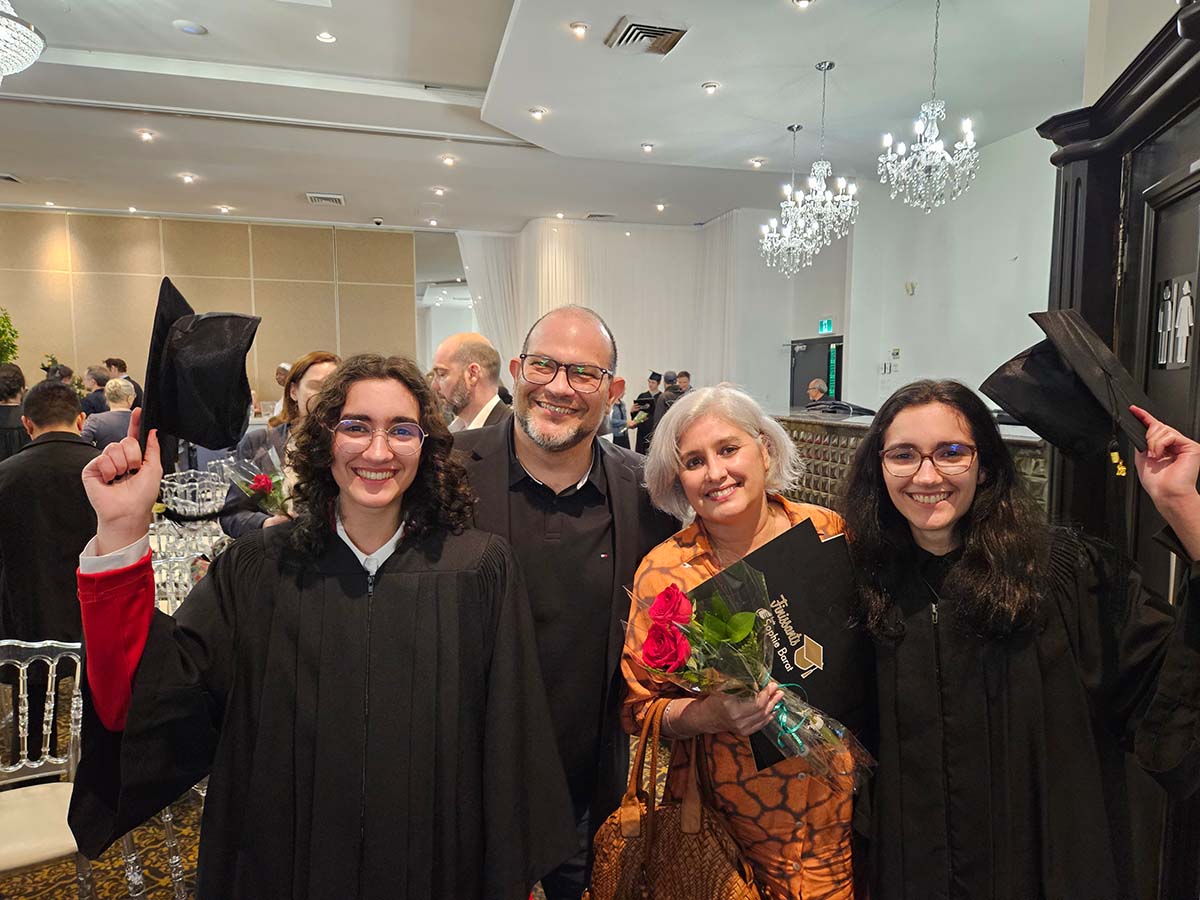
High school graduation - The parents were just proud after the honorable mentions they received during the ceremony.
Montreal’s choice was not random
The choice of Quebec was not random. We wanted an extra challenge with French, as we knew this language skill would be extremely valuable for our daughters’ future.
Without forgetting to mention that they are going to the fourth language (Spanish) at the moment. Owl father is like that, right?
Read also: “Living in Montreal: 12 Points that you should consider before living in this city”
Well, that’s what I had to say today. I hope this information helped once again. Want more tips like these? Sign up for our newsletter to receive updates about life in Quebec and your first steps as a newcomer.
See you in the next post! 😉

Marco Vasconcelos
Brazilian, webmaster, and e-commerce specialist living in Montreal since 2018. Founder of Você no Quebec, sharing practical guides, housing tips, and real-life experiences in the province to help Brazilian and international newcomers transition smoothly.
Read more about Marco →