Montreal Neighborhoods: The Island's 4 Regions Explained
Do not confuse the island of Montreal with Greater Montreal
Much is discussed about Montreal’s neighborhoods, their economic and cultural activity, in addition to the particularities of its more than 30 distinct neighborhoods. However, few people explain how the four regions of the city work.
In order to make up for this lack of information for newcomers to Montreal, I chose to create this guide to help them with their future decisions, whether they are considering residing in the city or just thinking about changing neighborhoods.
It is important to highlight that this text will focus exclusively on the Island of Montreal and its population of around 1.7 million inhabitants distributed across the city’s four regions.
As with any large city, especially as it is the second largest in Canada, behind only Toronto in Ontario, it is important to contextualize geographically to clarify that the areas adjacent to the Island of Montreal, such as Laval (to the north) or Longueuil (to the south), are part of Greater Montreal, but are distinct municipalities that make up the island’s suburbs, each with its own administration and regulations.
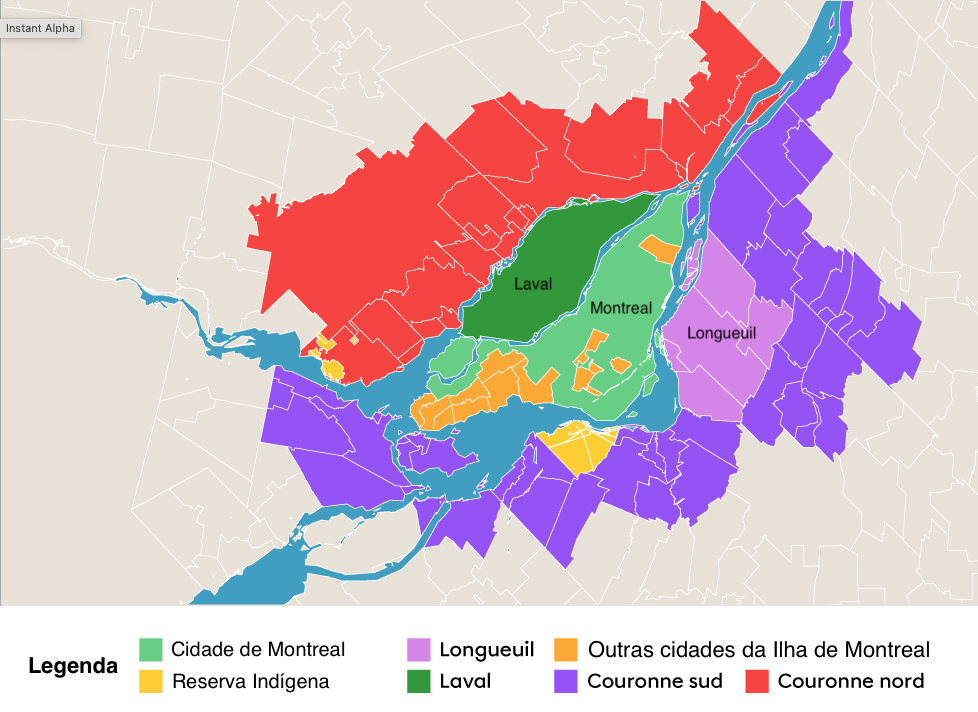
Map of the Greater Montreal Metropolitan Region by Regions - Source: alloprof
When I arrived in Quebec in 2018, my first stop was Laval. We lived there for a year before I realized that things work very differently when you cross the bridge.
For those who are fellow citizens of Recife, just make the same analogy when we look at Olinda and Jaboatão dos Guararapes as satellite cities of Recife.
You can even live in one of the two, but if you want to see things happening first hand, you’ll have to leave the suburbs and cross the bridge every now and then.
Read also: “Living in Montreal: 12 Points that you should consider before living in this city”
The Montreal metropolitan area is home to more than 4.5 million inhabitants, making it the most densely populated region in the province, with about half of Quebec’s total population.
Having made this clarification, let’s discuss some important facts related to the geography of Montreal and the distribution of its neighborhoods according to their regions and characteristics.
Montreal neighborhoods by region
Every new resident of a self-respecting city must begin his journey of geographic reconnaissance through the regions. In Montreal, knowing the region where you are going to live can influence several aspects, such as the rent, the public transport network, population density, the predominant ethnicity, schools and even the crime rate. That said, let’s list the main characteristics of each of them.
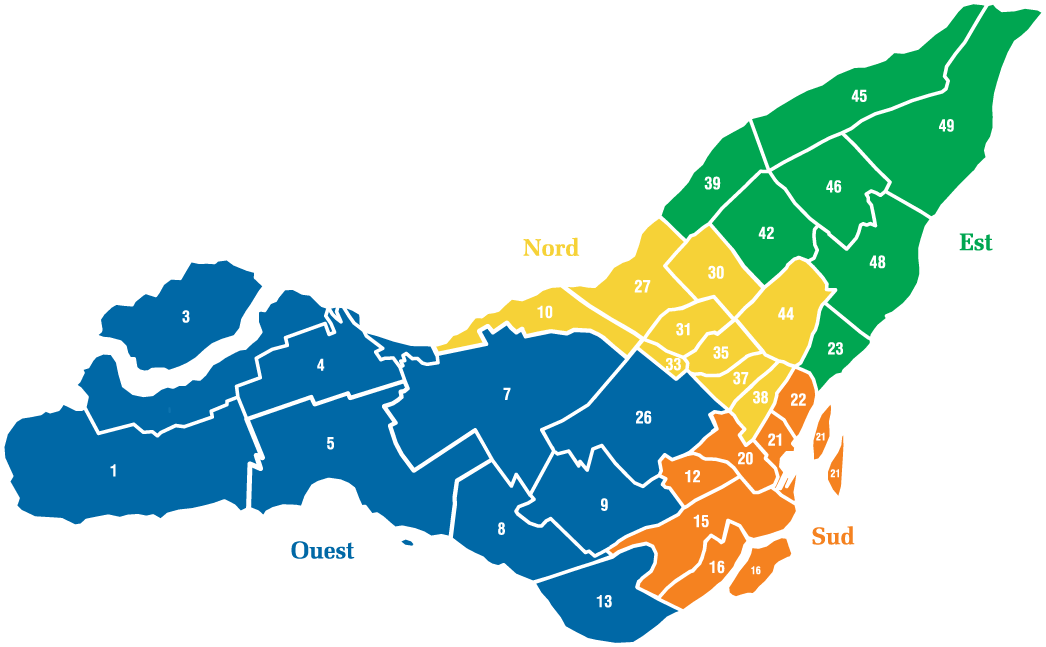
Map of the regions of Montreal, Quebec, Canada. For current territorial data, consult the Ville de Montréal official portal.
Labels: Ouest (West), Sud (South), Est (East) and Nord (North).
| Code | Neighborhoods | Region |
|---|---|---|
| 1 | Baie-d'Urfé, Beaconsfield, kirkland, Sainte-Anne-de-Bellevue, Senneville | West |
| 3 | L’île-Bizard, Pierrefonds, Sainte-Geneviève | West |
| 4 | Dollard-des-Ormeaux | West |
| 5 | Dorval, L’Île-Dorval, Pointe-Claire | West |
| 7 | Saint-Laurent | West |
| 8 | Lachine, Saint-Pierre | South |
| 9 | Côte-Saint-Luc, Hampstead, Montréal-Ouest, Notre-Dame-de-Grâce | West |
| 10 | Bordeaux, Cartierville | North |
| 12 | Ville-Marie Ouest, Westmount | South |
| 13 | LaSalle | West |
| 15 | Saint-Paul, Petite-Bourgogne, Pointe-Saint-Charles, Saint-Henri, Ville-Émard | South |
| 16 | Île-des-Sœurs, Verdun | South |
| 20 | Centre-ville (Ville-Marie Ouest), parc du Mont-Royal | South |
| 21 | Centre-ville (Ville-Marie Est), Île Notre-Dame, Île Sainte-Hélène, Vieux-Montréal | South |
| 22 | Centre-Sud | South |
| 23 | Hochelaga-Maisonneuve | East |
| 26 | Côte-des-Neiges, Mont-Royal, Outremont | West |
| 27 | Ahuntsic Ouest | North |
| 30 | Saint-Michel | North |
| 31 | Villeray | North |
| 33 | Parc-Extension | North |
| 35 | La Petite-Italie, La Petite-Patrie, Outremont | North |
| 38 | Le Plateau-Mont-Royal | North |
| 39 | Montréal-Nord | East |
| 42 | Saint-Léonard | East |
| 44 | Rosemont Est-Nord | North |
| 45 | Rivière-des-Prairies | East |
| 46 | Anjou | East |
| 48 | Mercier-Hochelaga-Maisonneuve | East |
| 49 | Montréal-Est, Pointe-aux-Trembles | East |
List of Montreal Neighborhoods by Region - Source: SPVM
Note! Anyone who knows Montreal a little will notice that some names of famous neighborhoods do not appear on this list. It is important to emphasize that there are other subdivisions of neighborhoods within larger neighborhoods listed in this table, but I will not talk about them in this post today to make the text less dense. This will be a topic for another post.
Not everything is Montreal within the island of Montreal
And a good example of this are the sociological neighborhoods or districts of Montreal. Considered as secondary cities within the island of Montreal (in yellow), they are a way of categorizing and understanding the city based on social, economic and demographic factors.
They are defined not only by their physical characteristics, but also by the social groups that inhabit them, their living patterns, culture and shared histories.
All neighborhoods on the map below identified in orange are part of the management of Montreal City Hall. The regions in yellow on the map have their own municipal administration that goes hand in hand with Montreal’s municipal management, however, they may have their own urban regulations, as in the curious case of Westmount.
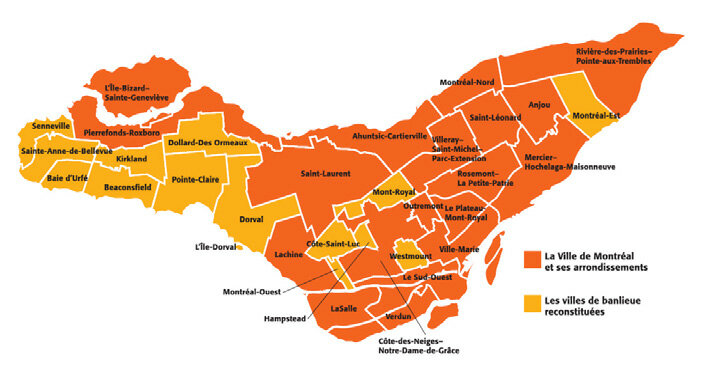
Map of sociological neighborhoods in Montreal - Source: Local
Westmount, in yellow and in the center of the map, is known for having a predominantly English-speaking population, although there is also a significant presence of French speakers. You’ll notice that even the traffic signs are all in English, making you feel like you’re in two worlds within Montreal.Read also: “Canadian census reveals that Quebec families are speaking less French at home”
Historically, Westmount has been an English-speaking community, especially among the older, more established residents. Many of the families who settled in Westmount during the 19th and early 20th centuries were of Anglo-Saxon origin, and English was the predominant language in their homes and in the wider community.
Discovering the four regions of the island of Montreal
Discovering the four distinct regions of the island of Montreal is like uncovering different chapters of a fascinating story. Each region has its own distinctive identity, offering a wealth of cultural, gastronomic and scenic experiences to explore.
From the vibrant and eclectic neighborhoods of the center to the picturesque suburban areas and the peaceful banks of the rivers that bathe this island with its unique charm and quirky attractions.
South Region of Montreal (Rive-Sud and Centre-Ville)
The center of Montreal Island represents the pulsating core of the city, bringing together a lively mix of cultural activities amid the chaos of its commercial areas and financial center, in addition to its elegant and sophisticated residential neighborhoods.
List of neighborhoods and districts: Lachine, Saint-Pierre, Ville-Marie Ouest, Westmount, Saint-Paul, Petite-Bourgogne, Pointe-Saint-Charles, Saint-Henri, Ville-Émard, Île-des-Sœurs, Verdun, Centre-ville (Ville-Marie Ouest), parc du Mont-Royal, Centre-ville (Ville-Marie Est), Île Notre-Dame, Île Sainte-Hélène, Vieux-Montréal and Centre-Sud.
Read also: “Montreal Neighborhoods: Verdun Guide”
| Highest-rated neighborhoods 👍 | Lower-rated neighborhoods or areas 👎 |
|---|---|
| Westmount Verdun Vieux-Montréal Lachine Île-des-Sœurs Saint-Pierre | Centre-ville Est-Vieux-Montréal Centre-Ville-Parc Mont-Royal |
* The criteria used take into account local administration, cleaning and conservation, as well as the safety index.
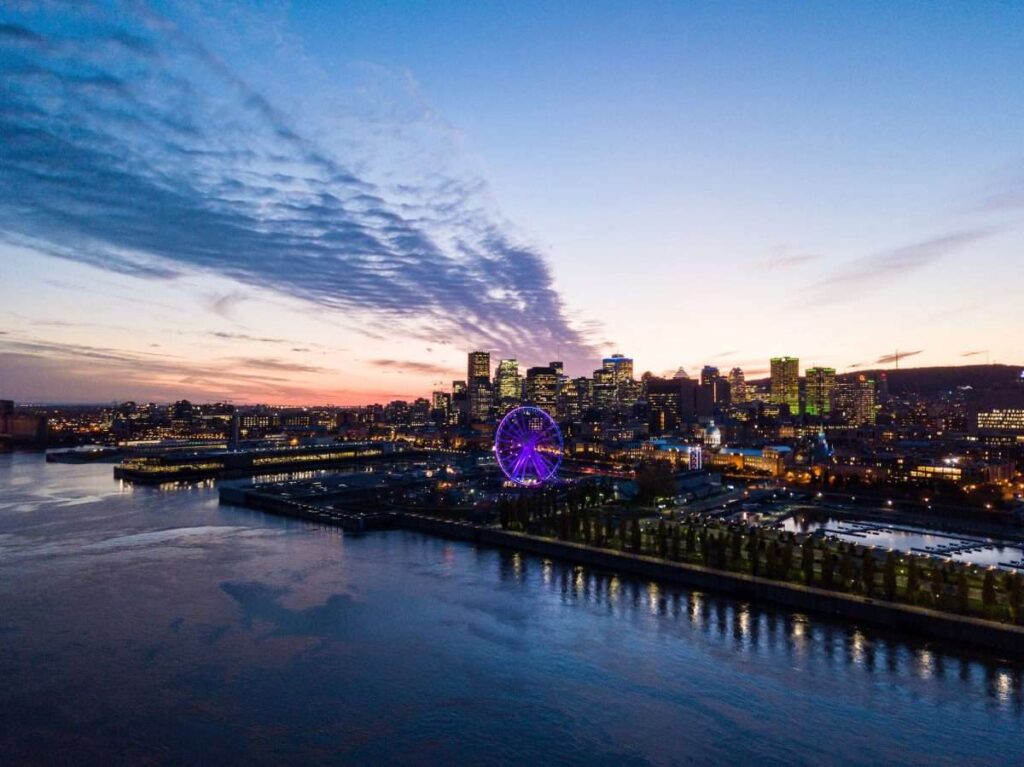
Centre-Ville de Montreal - Source: Image Bank
**Here are some important aspects about this region:**1. Highlights: The central region is home to Montreal’s financial district, where major banks, financial institutions and financial services companies are located. Imposing skyscrapers dominate the skyline, reflecting the area’s economic dynamism. 2. Culture and Entertainment: The central region is home to many of the city’s main cultural and entertainment institutions, such as the Montreal Museum of Fine Arts, the Quartier des Spectacles (entertainment district), theaters, art galleries, cinemas and a multitude of restaurants, bars and cafes. 3. Commerce and Retail: Streets like Rue Sainte-Catherine are known for their concentration of retail stores, boutiques, shopping malls and department stores. This is a busy area for shopping and tourism, with a variety of options to suit all tastes and budgets. 4. Residential and Urban Life: Although predominantly a commercial and cultural area, the central region also has a significant residential community. Many historic buildings have been converted into apartments, and there is a mix of luxury condos and more affordable housing units. Urban life flourishes here, with a lively atmosphere and a diversity of people and cultures. 5. Transport and Accessibility: The central region is well served by public transport, including metro stations, buses and public bicycles. Additionally, many areas are easily accessible on foot, making it convenient for residents and visitors alike. 6. Crime rates: The southern region of the Island of Montreal is a mix of residential, industrial and commercial areas. Crime rates can vary significantly between neighborhoods, with some areas experiencing crime-related problems such as theft and vandalism, while others enjoy greater security and tranquility. This may not be your best choice for raising minor children. 7. Schools: This region is widely recognized for its higher education institutions, which house a variety of technical education, undergraduate and postgraduate centers in its prestigious world-class units, such as McGill and Université de Montréal. It is considered a true amusement park for university students. For this same reason, educating young children in public schools is considerably more challenging in this area. 8. Pollution: Despite having Mont-Royal Park as its postcard and city’s lungs, this region also suffers not only from a high level of pollution from industries and intense car traffic. Furthermore, noise pollution is one of the worst in Montreal. 9. Housing: Living with all this convenience and diversity on the banks of the beautiful Saint-Laurent River, comes with a price, as this is one of the most expensive areas to live in Montreal, especially for those who wish to establish residence in Centre-Ville, the most upscale area of Montreal. 10. Ethnicity and Language: Montreal’s wealthiest residents live in this area, so don’t expect to find high-end residences occupied by immigrants, with the exception of university students who come from different parts of the world. Here, bilingualism (French and English) is prevalent, but there are those who claim that English speakers constitute the majority among the better off.
Read also: “Learn the difficult art of parking in Montreal: Complete Guide”
| South-Central Montreal | Rating |
|---|---|
| Accessibility and transportation | ⭐️⭐️⭐️⭐️⭐️ |
| Green spaces (parks) | ⭐️⭐️⭐️⭐️ |
| Environment and pollution | ⭐️⭐️ |
| Safety | ⭐️⭐️⭐️ |
| Beauty and architecture | ⭐️⭐️⭐️⭐️⭐️ |
| Nightlife | ⭐️⭐️⭐️⭐️⭐️ |
| Leisure | ⭐️⭐️⭐️⭐️⭐️ |
| Community activities | ⭐️⭐️⭐️⭐️⭐️ |
| Shopping | ⭐️⭐️⭐️⭐️⭐️ |
| Art and culture | ⭐️⭐️⭐️⭐️⭐️ |
| Tourist appeal | ⭐️⭐️⭐️⭐️⭐️ |
| Housing affordability | ⭐️⭐️ |
| Good for young children | ⭐️⭐️⭐️ |
* The criteria provided are a synthesis of information from various classifications available on the internet, combined with my personal observations.
West Region of Montreal (The Enchantment of the Countryside)
City and vegetation: an unbeatable combination. With four natural parks, three wooded areas and a variety of modern and residential neighborhoods, the west side of Montreal offers a quality of life that far surpasses other regions of the city.
Also read: “How to use public transport in Montreal”
And don’t be surprised to see one of these friendly visitors (photo of the deer) walking near your garden in the mornings.
List of Neighborhoods and Districts: Baie-d’Urfé, Beaconsfield, kirkland, Sainte-Anne-de-Bellevue, Senneville, L’île-Bizard, Pierrefonds, Sainte-Geneviève, Dollard-des-Ormeaux, Dorval, L’Île-Dorval, Pointe-Claire, Saint-Laurent, Côte-Saint-Luc, Hampstead, Montréal-Ouest, Notre-Dame-de-Grâce, LaSalle, Côte-des-Neiges, Mont-Royal and Outremont.
| Highest-rated neighborhoods 👍 | Lower-rated neighborhoods or areas 👎 |
|---|---|
| Notre-Dame-de-Grâce Pointe-Claire Pierrefonds Sainte-Anne-de-Bellevue | Sainte-Geneviève Côte-des-Neiges Dorval Saint-Laurent(some areas) LaSalle(some areas) Montréal-Ouest |
* The criteria used take into account local administration, cleaning and conservation, as well as the safety index.

West Region of Montreal - Source: Image Bank
**Here are some important aspects about this region:**1. Highlights: Countryside landscape and progress go hand in hand. This region is home to several recognized companies in life sciences, healthcare and aerospace technologies. With an impressive land area, the municipality of Sainte-Anne-de-Bellevue is also home to McGill University’s Macdonald campus and its 245-hectare floral reserve is accessible to all. 2. Culture and Entertainment: Don’t expect the hustle and bustle of Downtown Montreal here; the atmosphere is more focused on good restaurants and outdoor activities. If you need something to do indoors, there are a variety of stores and shopping centers to escape the cold. 3. Residential and Urban Life: It’s not just the trees and flowers that grow here: children too. West Montreal provides a peaceful and green environment for future generations to thrive. With several natural parks, children have the opportunity to engage in a wide variety of outdoor activities. 4. Transportation and Accessibility: West Montreal is already well served by several suburban trains, including the orange and blue metro lines. REM went into operation in July 2023 and has been expanding ever since: the Deux-Montagnes antenna opened in November 2025 and the Anse-à-l’Orme antenna, which serves the West of the Island, entered service on May 18, 2026, with stations Des Sources, Fairview–Pointe-Claire, Kirkland and Anse-à-l’Orme. The connection to Trudeau Airport (YUL) is still under construction, expected to open in spring 2027. However, in this region, it is essential to have a car, as distances are considerable for a relatively limited bus network, especially when compared to the city center. 5. Crime rates: Crime rates are generally very low in more residential areas, but this changes a bit around the international airport. 6. Schools: This is undoubtedly an ideal place to raise young children. There are excellent primary and secondary schools, which also offer a wide range of teaching programs in French and English. 7. Pollution: The combination of low population density and fewer industries makes this region one of the best in air quality in Montreal. 8. Housing: Living in the western region of the Island of Montreal can be expensive, especially in more prestigious neighborhoods close to the city center. However, residents who choose more distant areas in the far west of the island are often able to live in larger properties for much less than in the center. Just keep in mind that you will need a car for everything. 9. Etina and Language: Montreal’s wealthiest residents also live in this area, contrasting with suburban bubbles as opposed to elegant luxury condominiums. This is a side of the city where French is less present, especially among the wealthier. Unlike the southern region, this is not a territory of native Quebecers. There are many Orientals and occupying this area in recent years.
Read also: “How to buy a used or new car at the lowest price in Canada in 10 steps”
| West Montreal | Rating |
|---|---|
| Accessibility and transportation | ⭐️⭐️⭐️ |
| Green spaces (parks) | ⭐️⭐️⭐️⭐️⭐️ |
| Environment and pollution | ⭐️⭐️⭐️⭐️⭐️ |
| Safety | ⭐️⭐️⭐️⭐️ |
| Beauty and architecture | ⭐️⭐️⭐️ |
| Nightlife | ⭐️⭐️ |
| Leisure | ⭐️⭐️⭐️⭐️ |
| Community activities | ⭐️⭐️⭐️⭐️ |
| Shopping | ⭐️⭐️⭐️⭐️ |
| Art and culture | ⭐️⭐️ |
| Tourist appeal | ⭐️⭐️ |
| Housing affordability | ⭐️⭐️⭐️⭐️ |
| Good for young children | ⭐️⭐️⭐️⭐️⭐️ |
* The criteria provided are a synthesis of information from various classifications available on the internet, combined with my personal observations.
North Region of Montreal (Place where history and nature mix)
From now on, I can speak with even more confidence, as this region has been my home since 2020. It is common for many newcomers to Montreal to receive a strong warning about this region, as there is a huge geographic misunderstanding about it.
Firstly, one of the least safe neighborhoods in Montreal is called Montreal-North, but interestingly, it is not part of the northern region in terms of delimitation.
If you refer to the second map in this post, in order from top to bottom, you will notice that neighborhood number (39), called Montréal-Nord, is part of the eastern region of Montreal.
Read also: “Montreal Neighborhoods: Guia Ahuntsic-Cartierville”
List of Neighborhoods and Districts: Bordeaux, Cartierville, Ahuntsic Ouest, Saint-Michel, Villeray, Parc-Extension, La Petite-Italie, La Petite-Patrie, Outremont, Le Plateau-Mont-Royal and Rosemont Est-Nord.
| Highest-rated neighborhoods 👍 | Lower-rated neighborhoods or areas 👎 |
|---|---|
| Outremont Ahuntsic Le Plateau-Mont-Royal La Petite-Patrie | Saint-Michel Villeray Bordeaux |
* The criteria used take into account local administration, cleaning and conservation, as well as the safety index.
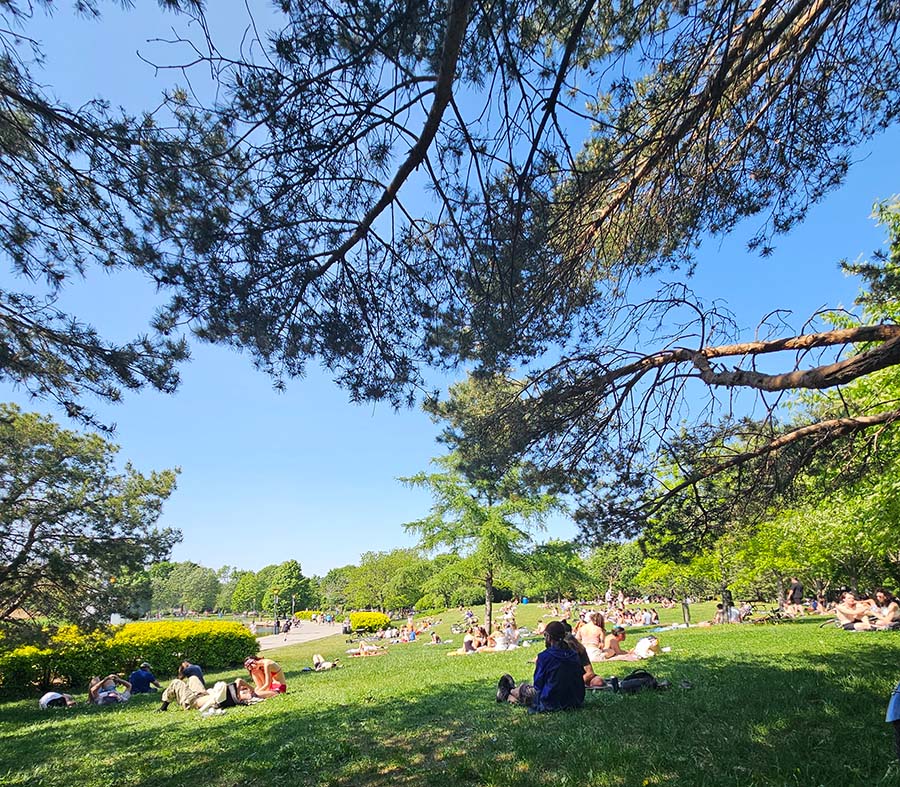
Parc Jarry in Montreal North - Source: Personal archive
**Here are some important aspects about this region:**1. Highlights: The banks of the Prairies River may not have the same glamor as those of the Saint-Laurent River, but they certainly leave nothing to be desired in terms of natural beauty, especially with its stunning landscapes at sunset. This is one of the things I most enjoy contemplating during the summer, whether during a walk with my wife or on a bike ride. Furthermore, this region is home to the largest concentration of urban parks in Montreal. 2. Culture and Entertainment: Despite being far from the hustle and bustle of the center, this region is the pulsating epicenter of cultural and ethnic activities, housing a significant portion of the first immigrants who arrived between the 1920s and 1950s. This diversity is manifested in small festivals, such as those in the Italian, Latin, Portuguese, Jewish and African neighborhoods. 3. Residential and Urban Life: This is a traditionally residential neighborhood, with small specialized commercial establishments. Don’t expect to find large supermarkets or shopping centers like in the suburbs and the center, but that is precisely the charm of the region, which has a hipster atmosphere. It is also important to mention that we are referring to one of the most French-speaking regions of Montreal. 4. Transportation and Accessibility: Public transport is efficient, with good availability of subways, buses and cycle paths. However, the REM still does not fully serve this region as expected, due to considerations regarding the preservation of historic urban heritage. 5. Crime rates: Among the four regions of Montreal, this can be considered the second calmest, behind only the West region, but this varies greatly depending on the neighborhood in which you live. Overall, this is a quiet area to raise young children. 6. Schools: In this region, primary and secondary schools and CEGEPs (Colleges) are the highlights. Depending on your child’s educational goals, this may be a neighborhood where you can easily settle for many years, ensuring transportation convenience for your child. 7. Pollution: Located in the center of the island, this region faces considerable levels of industrial pollution brought by easterly winds, especially in the more central areas of the island, where smoke from the industrial region in the east of Montreal is often transported to the city center. However, the impacts are significantly smaller for those living close to the riverbanks. 8. Housing: Living in the northern region of the Island of Montreal can be expensive and challenging. It is one of the oldest areas of the city, with a strong preservation of urban heritage, which is reflected in the scarcity of tall buildings and limited real estate expansion. Get ready to find many properties that are over 70 years old. Even after renovations, they can represent a hindrance in terms of availability, leading to higher rental costs. 9. Ethnicity and language: We are referring to the middle class of Montreal, therefore, this region is recognized as the most democratic and diverse in terms of coexistence between immigrants and natives. French is predominant here, but you are quite likely to meet many immigrants who are fluent in three languages due to their strong ancestral and cultural roots. Furthermore, it is home to several generations of Quebecois families.
| North Montreal | Rating |
|---|---|
| Accessibility and transportation | ⭐️⭐️⭐️⭐️⭐️ |
| Green spaces | ⭐️⭐️⭐️⭐️⭐️ |
| Environment and pollution | ⭐️⭐️⭐️⭐️ |
| Safety | ⭐️⭐️⭐️⭐️ |
| Beauty and architecture | ⭐️⭐️⭐️ |
| Nightlife | ⭐️⭐️⭐️⭐️ |
| Leisure | ⭐️⭐️⭐️⭐️ |
| Community activities | ⭐️⭐️⭐️⭐️⭐️ |
| Shopping | ⭐️⭐️⭐️⭐️ |
| Art and culture | ⭐️⭐️⭐️⭐️ |
| Tourist appeal | ⭐️⭐️⭐️⭐️ |
| Housing affordability | ⭐️⭐️⭐️ |
| Good for young children | ⭐️⭐️⭐️⭐️ |
* The criteria provided are a synthesis of information from various classifications available on the internet, combined with my personal observations.
East Region of Montreal (Definitely a region that needs more attention from the state)
We finally arrived at the less favored region of Montreal. The east of the city also shares some characteristics of its rich cousin, the West region, such as low demographic density and lack of a more comprehensive transport infrastructure.
Furthermore, it stands out for its picturesque landscapes along the banks of the rivers, however, the similarities end there.
Read also: “How to find cheaper rentals in Montreal”
The historic presence of industries in this area attracted a working class who settled in the surrounding area, playing a key role in the formation of many suburban neighborhoods in Montreal. Today, this region displays a unique and vibrant identity in neighborhoods like Mercier-Hochelaga-Maisonneuve, but it also carries with it a certain air of decay in poorer areas.
I studied for 18 months at a college located in the Hochelaga neighborhood and was able to see these contracts up close.
This region is also considered one of the most impoverished in the city, so it is common to witness neighborhoods like Montreal North (except on the banks of the river) dealing with the proliferation of tenements and gang violence.
List of Neighborhoods and Districts: Hochelaga-Maisonneuve, Montréal-Nord, Saint-Léonard, Rivière-des-Prairies, Anjou, Mercier-Hochelaga-Maisonneuve, Montréal-Est and Pointe-aux-Trembles.
| Highest-rated neighborhoods 👍 | Lower-rated neighborhoods or areas 👎 |
|---|---|
| Rivière-des-Prairies Mercier-Hochelaga-Maisonneuve Anjou | Montréal-Nord Saint-Léonard Pointe-aux-Trembles Montréal-Est |
* The criteria used take into account local administration, cleaning and conservation, as well as the safety index.
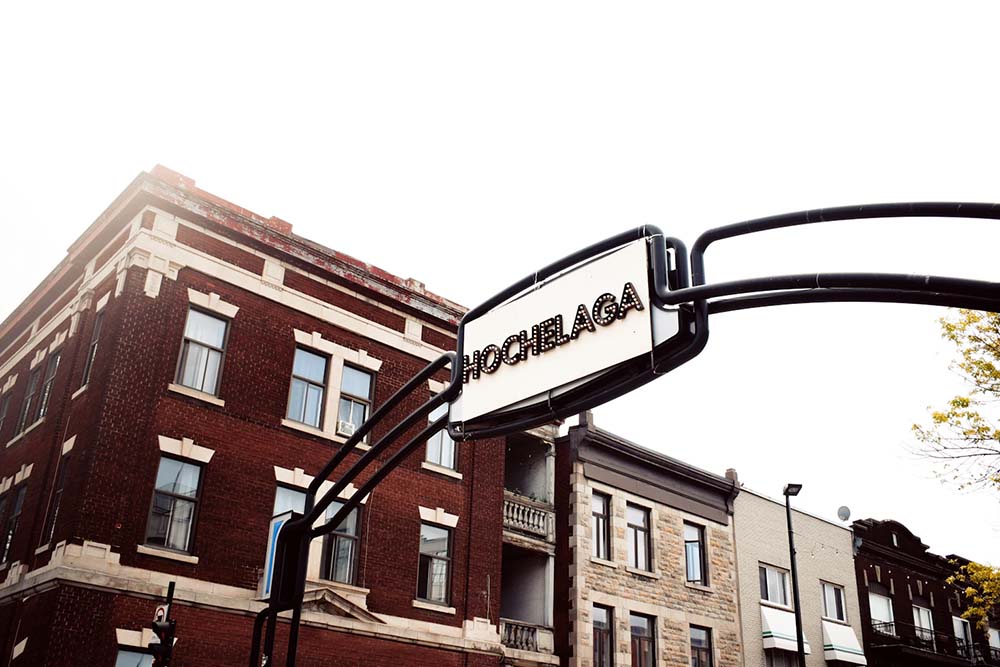
East Region of Montreal - Source: Image Bank
Here are some important aspects about this region:
- Highlights: If you have the possibility of living on the banks of the rivers that bathe this area, you will notice a big difference in terms of quality of life. However, outside that comfort zone, there may be fewer charms to highlight.
- Culture and Entertainment: This is not exactly a region known for its fun, as there is little government investment to promote it, mainly limited to community events. The same rule mentioned in the previous point applies here: if you live near the river, leisure and contact with nature can compensate for this disadvantage.
- Residential and Urban Life: This is a neighborhood with an industrial tradition, yet with extensive areas of agricultural cultivation. The impoverishment of the population in this region is evident in many neighborhoods, reflected in higher crime rates and lower social well-being.
- Transportation and Accessibility: Public transport in this region is not as comprehensive as in other areas of Montreal, which limits travel options to buses (with few lines), some train networks and just two metro stations on the green line on the south side. If you are looking for comfort, you will need a car to live here.
- Crime rates: Although not everything is gloomy in this region, if we compare its crime level with other areas of Montreal, it is by far the least attractive for raising young children or leaving your car parked on the street overnight.
- Schools: For reasons similar to those already mentioned, this is a region neglected by Montreal’s public policies. So don’t expect to find high-quality schools for your children, although there are a few well-rated ones. The problem, in this case, lies in the environment in which the school is located.
- Pollution: The south side of this region has many industries and as a result, the air quality is not what you would call ideal.
- Housing: Given all the unfavorable aspects mentioned in relation to the region, it is natural to expect an offer of more affordable properties, and this actually occurs. Unlike the North region of Montreal, which is facing limited real estate expansion due to issues of preserving historical heritage, here it is common to see large developments of new apartments in contrast to the city’s more marginalized surroundings.
| East Montreal | Rating |
|---|---|
| Accessibility and transportation | ⭐️⭐️ |
| Green spaces | ⭐️⭐️⭐️ |
| Environment and pollution | ⭐️⭐️ |
| Safety | ⭐️⭐️ |
| Beauty and architecture | ⭐️⭐️ |
| Nightlife | ⭐️⭐️ |
| Leisure | ⭐️⭐️⭐️ |
| Community activities | ⭐️⭐️⭐️ |
| Shopping | ⭐️⭐️⭐️ |
| Art and culture | ⭐️⭐️ |
| Tourist appeal | ⭐️ |
| Housing affordability | ⭐️⭐️⭐️⭐️ |
| Good for young children | ⭐️⭐️⭐️ |
* The criteria provided are a synthesis of information from various classifications available on the internet, combined with my personal observations.
Bonus
If you are new to Montreal and want to explore the city’s history in more depth, I highly recommend watching this documentary series called Montréal: My Love, My Story available on Amazon Prime.
Here’s an excerpt from the first episode that I found available on YouTube, but if you have a Prime account you can watch it at this link here 👉 Montréal: My Love, My Story
There are five episodes lasting almost an hour that address the history of this city on a very deep level.
This is a great way to start understanding more about the place you live, or even for those who are thinking about moving here.
Although the series was recorded in 2017 and may be a little out of date, I can assure you that it is much better than a lot of content found on YouTube, which is often riddled with errors when it comes to historical references.
An example of this was the recent episode produced by Rede Globo about the province of Quebec, presented on Globo Repórter.
There were so many historical reference errors that it is embarrassing to recommend. Still, for those who haven’t seen it, I suggest watching it after watching the Amazon Prime series I mentioned.
You can watch it at this link 👉 French origins are a source of pride in Quebec, Canada
With that, I close for today. Don’t forget to sign up for our newsletter to receive weekly updates on how to prepare for this journey we affectionately call immigration.
See you in the next post! 😀

Marco Vasconcelos
Brazilian, webmaster, and e-commerce specialist living in Montreal since 2018. Founder of Você no Quebec, sharing practical guides, housing tips, and real-life experiences in the province to help Brazilian and international newcomers transition smoothly.
Read more about Marco →