

Francisation in Quebec: 7 Truths Newcomers Should Know
| Updated in August 2026. Since July 2023 everything goes through Francisation Québec, the single input port of MIFI, the multiple parallel paths I describe later no longer exist. Three things that have changed since then and that interest you: (1) waiting lines have shrunk significantly and the offer has expanded in the regions; (2) demand fell, around 77 thousand people took courses between April 2025 and February 2026, compared to more than 91 thousand in the previous period, which means more chance of getting a place today than two years ago; (3) On the other hand, French became a tough requirement in immigration, the PEQ was reactivated requiring command of the language for the majority of candidates, without the old exemption for work experience. Translation: it became easier to study French and more difficult to immigrate without it. |
What is the Francisation Program in Quebec?
The Francisation program in Quebec refers to a government initiative in the French-speaking province of Canada designed to assist new immigrants in developing language skills in French.
The main objective is to facilitate the integration of these individuals into society and the local job market, providing courses and resources that aim to improve their proficiency in the French language.
The program covers several aspects, from formal classes to practical activities designed to promote effective immersion in the French-speaking language and culture, thus contributing to a smoother and more successful transition for newcomers.
Additionally, the program aims to strengthen the use of French within the province, a controversial topic among some representatives of the nationalist government. These leaders make a point of highlighting a continued decline in language use, expressing this concern through statements like these:
“Temporary foreign workers are contributing to the anglicization of Quebec”
Jean-François ROBERGE
Read also: “Canadian census reveals that Quebec families are speaking less French at home”
Benefits of Francisation in Quebec for immigrants
The Francisation program in Quebec offers several benefits, including:
- Cultural Integration: Provides effective immersion in French-speaking culture, helping immigrants adapt more easily to the local lifestyle.
- Job Opportunities: By improving language skills in French, participants increase their chances of entering the job market, contributing to strengthening the local economy.
- Free and Financial Aid: French courses are free. You have no registration fees or monthly fees to pay. In some cases, the program may offer financial assistance through scholarships to support participants during the Francisation process, alleviating financial burdens.
- Access to Services: Becoming proficient in French facilitates access to public services, education and healthcare, ensuring a smoother transition to life in Quebec.
- Effective Communication: Improves communication skills in French, allowing for more effective interaction with co-workers, neighbors and the community in general.
- Promotion of the French Language: Contributes to the preservation and promotion of the French language in the province, meeting the cultural and linguistic objectives of the local government.
Read also: “5 major cultural differences between Quebec and other provinces in Canada”
Who can do Francisation in Quebec?
The Francisation program in Quebec is generally intended for permanent residents of Canada, including those who have chosen to reside temporarily in the province of Quebec. Additionally, you must be 16 years of age or older and must be residing in the province of Quebec.
Those eligible to participate typically include:
- New Immigrants: People who have recently obtained permanent resident status in Canada, especially those who have chosen to live in Quebec, are often encouraged to participate to improve their French skills.
- Temporary residents in Quebec: Temporary workers, international students and asylum seekers may qualify depending on their status and circumstances. Applicants may need documents such as a Quebec Acceptance Certificate (CAQ) and a Social Insurance Number (SIN).
- Individuals with Francisation Needs: People who, despite already residing in Quebec, need to improve their language skills in French for better social, cultural and professional integration.
It is important to check the specific requirements of the program you intend to apply for, as there may be variations in relation to the eligibility criteria. Furthermore, the information and criteria may be updated over time, therefore it is recommended to consult the official sources of the Francisation program in Quebec for the most recent and accurate information.
Modalities and duration of Francisation Courses in Quebec
1. Francisation - Part-time (Les cours à temps partiel)
Part-time classes are conducted in the following ways:
- In person or, when necessary, remotely; During the day or at night; On weekdays (Monday to Friday) or weekends (Saturday or Sunday).
- The number of hours per week can vary, offering options of 4, 6, 9, 12, 15 or 20 hours, with flexible schedules that can be distributed across days (Mondays, Wednesdays and Fridays) or (Tuesdays and Thursdays only). This variation may occur according to the specific policies of each educational center.
For more information, go to this link.
2. Francisation - Full time (Le cours à temps complet)
Full-time classes are conducted in the following ways:
- In the classroom or, if necessary, remotely;
- 5 days a week (Monday to Friday);
- 25 to 30 hours per week.
For more information, visit this link.
All programs have a scale of levels and durations that may vary depending on the workload, ranging from level 1 to 8. Each level corresponds to a session, equivalent to a season of the year, commonly lasting 10 weeks.
3. Francisation - Online courses for people selected to immigrate to Quebec
If you are still in the immigration process in Brazil and already have a valid Quebec Selection Certificate (CSQ) or Certificate of Acceptance of Quebec (CAQ), it is possible to start the Francisation program even before arriving in the province. For more information, go to this link.
4. Francisation Specialized courses by employment area
These courses will allow you to improve your French in a specific area of employment, whether for work or study. There are specialized French courses in the following areas of employment:
- Administration, Law and Business;
- Engineering and Applied Sciences;
- Health;
- Nursing.
For more information, visit this link.
Where are Francisation courses taught in Quebec?
Part-time: Part-time or full-time classes are taught at school service centers, school boards and Quebec government partner organizations. You will need to choose the training location where you want to take your course when you register.
Full-time: A full-time course will be offered to you no matter where you live in Quebec. Classes are taught at: Universities, Cegeps, Community organizations and School service centers or school councils. For full-time courses, we will offer a training location based on: Your education level, your preferred training location and the availability of facilities.
Some courses are taught remotely to meet the needs of certain clients. You must be in Quebec to take a distance learning course.
How to enroll in a Francisation program in Quebec?
- Registration for the Chosen Program: After choosing the program, you must register directly on the official website of the Francisation program in Quebec. Complete the application form with accurate information.
- French Level Assessment: Some programs may require you to take an assessment of your French level. This can be done through specific tests or interviews.
- Wait for Acceptance: After submitting your application, wait for the evaluation and possible acceptance into the program. Selection criteria may vary, and acceptance will depend on the availability of places.
- Class Participation: Once accepted, actively participate in classes and program activities. Be committed to improving your language and cultural skills. (more than two consecutive absences without an acceptable justification may result in cancellation of your registration)
- Monitoring and Assessment: During the program, there may be regular assessments of your progress. Make sure you make the most of the learning opportunities on offer.
 Information important! Information important!In July 2023, the Francisation program in Quebec underwent significant changes in its course management policy, as well as in schools and support centers. Previously, the centers were responsible for the entire registration process, vacancy management, evaluation and acceptance of new candidates. All you had to do was choose the center and register in person. Center changes, class reclassification and other demands were simpler and faster, as each center had a certain autonomy. With the changes, the MIFI (the body responsible for immigration and francization in Quebec) centralized control, resulting in significant problems with delays in registrations. Seemingly simple actions, such as transferring to another center due to a change of address, have become a nightmare, as everything is now managed by the ARRIMA portal (the same one used for immigration in Quebec), and the entire process must be carried out online. The choice of centers is now a criterion determined by them, and, as all communication is in French, additional effort is required to clarify doubts. Fortunately, some centers still offer in-person registration support, CACI being one of them. |
Discover the 7 truths that no one tells you about the Francisation program in Quebec
After explaining the basics of the program, let’s talk about Francisation in Quebec and give some useful advice on how to best deal with it.
For beginners, it’s good to know that, even if you studied French before arriving in Quebec, the French spoken here can initially feel like another language. Think of the difference between Brazilian and European Portuguese.
Read also: “Quebec for Brazilian newcomers: Tips on local culture”
Furthermore, I would like to emphasize that what I am going to share here represents exclusively my perspective on the program, also shared by many other immigrant friends who have gone through this experience.
Another aspect to highlight is that the quality of the institutions I will mention may have been improved, since I started my French studies in Quebec in 2019.
In short, the program is far from being an optimized tool for learning French, and there are several reasons for this, which I will list below.
1. Quality and professionalism of Teachers (This is not the rule)
Due to the large demand for new immigrants and the growing shortage of professionals in the market, it is common to find teachers without the necessary teaching experience. Many teach classes in this program as a way to supplement their income, as they are also teachers in the public network, in primary and secondary schools in Quebec. The fatigue and lack of motivation in some of them are easily noticeable.
Based on my personal experience, only 3 of the 8 teachers I had were competent professionals and committed to the program.
2. Lack of native Quebec teachers
For the same reason mentioned above, it is quite rare to find teachers who are native to Quebec. In large centers like Montreal, you’re likely to hear a variety of accents coming from former French colonies like Haiti, Senegal, Algeria, Morocco, among others. This means, in practice, that contact with local French often does not actually occur, being less noticeable in study centers located in smaller cities.
Based on my personal experience, only 1 of the 8 teachers was a Quebec native.
3. Quality of Facilities (This is not the rule)
Depending on the location, the quality of the facilities offered may surprise you. I had the opportunity to study at three centers, luck being in my favor, as two of them had impeccable quality. However, it is important to note that quality can vary, as I experienced in a center in Laval.
Based on my personal experience, I will also list the Francisation centers in Quebec that I attended in the chronological order that I studied.
#01 - Centre Lartigue
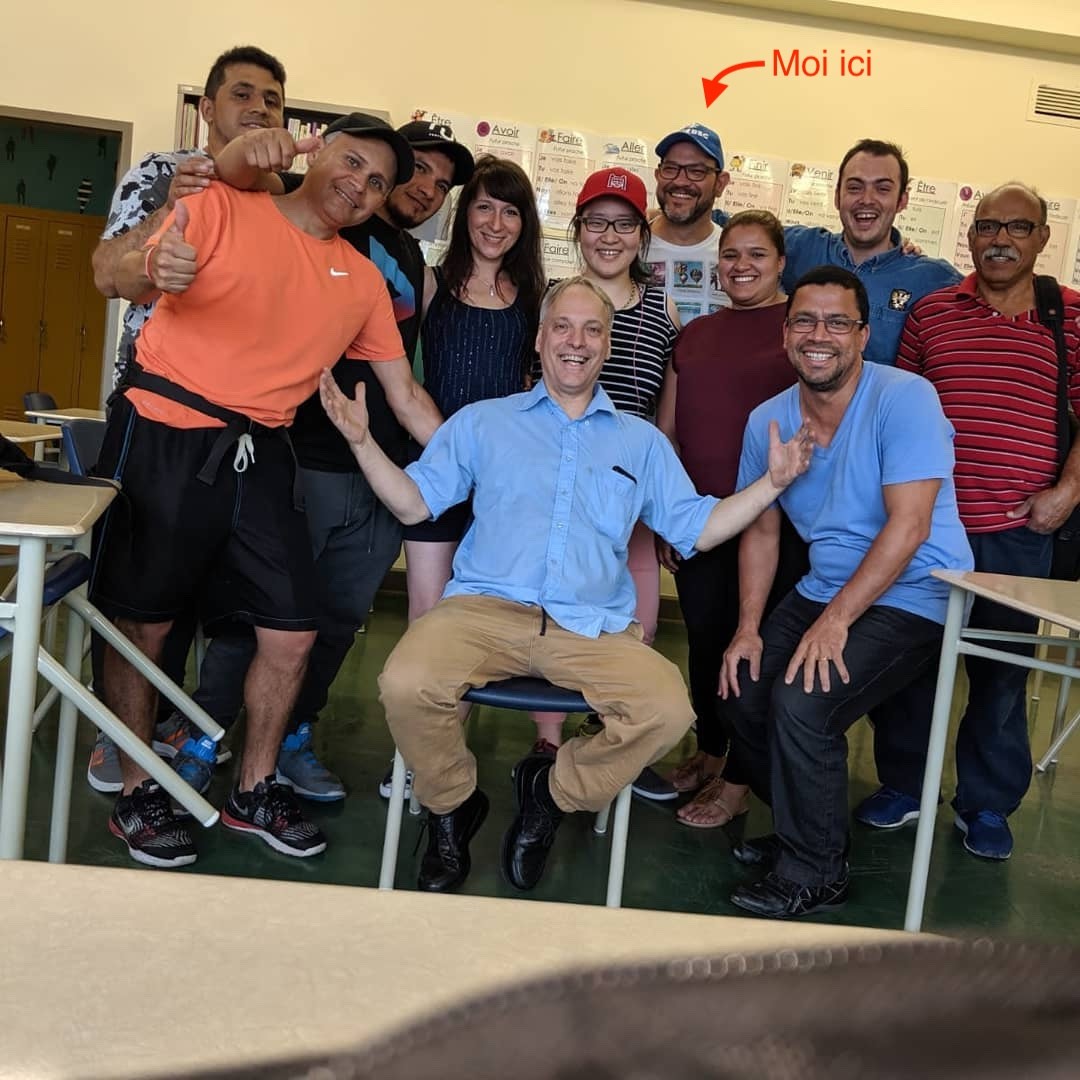
My French class at Center Lartigue - Source: Personal archive
An excellent center in Montreal, it was there that I started learning French with a native Quebec teacher, Monseigneur André, who did an exceptional job. At that moment, I realized how crucial the combination of a talented teacher and a quality institution can be. (Rating 9/10)
Due to its location in the center of Montreal, there is a wide diversity of immigrants, without a specific ethnic predominance. In my two classes, I had the opportunity to interact with people from Asia, South America, Europe and even the United States.
Positive points include the infrastructure, access to public transport and the location very close to La Fontaine Park. However, some negative points to consider are the opening hours, the long wait for spaces and the lack of parking space.
#02 - Carrefour D’Interculture De Laval

Carrefour DInterculture De Laval - Source: Google Maps
The lack of structure combined with low quality teachers resulted in a complete disaster in my second experience in the Francisation program.
Because it is located in Chomedey, Laval, the class brought together many students from Arab-speaking communities. For me, the two highlights were the easy parking and the pleasure of meeting one of the best French teachers I had in Quebec, M. Ahcene, an Algerian with impeccable French. (Rating 5/10)
#03 - CACI - Support Center for Immigrant Communities
This was my most recent experience in the program, and I can say that, in terms of infrastructure, it was the best of all, as the facilities, in addition to being new, are very well maintained. As for the teaching staff, I found teachers with good to average performance.
You will notice a predominance of Arab, African and Spanish immigrants in most classes.
Positive points include the location, a great cafeteria, daycare services for children and students, as well as easy parking and services available to help immigrants. But be aware that the waiting list is long.
In fact, it was there that I had my first experience as a volunteer in Quebec, working as an assistant in filling out income taxes for needy people. (Rating 7/10)
#04 - Online Classes (Taught by CACI)
During the pandemic, my experience was disheartening when all courses were conducted online. Dealing with a class of approximately 16 people, each with different accents and unclear audio quality, was one of the reasons I temporarily stopped my course. (Rating 4/10)
4. Teaching material and outdated content
Although the francisization program was created with good intentions, it is notable that a significant portion of the content needs to be updated. This includes videos and audios that are 10 years old or older. Considering that the content aims at integration in the province, it is crucial that it represents the current reality and context of life in Quebec.
When you have the opportunity to study with a qualified teacher, you will realize that the introduction of new content outside the original scope of the course, along with dynamics and games, will make the class significantly more productive.
5. Incoherent level assessment
It is common to observe classmates who are not clearly able to progress to higher levels without a visible improvement in speaking and reading. This can be discouraging, especially at intermediate levels of the course.
6. The real attraction for immigrants is the financial support provided by the program
I’m not making any judgments about anyone’s situation here, but during my three years participating in the francization, with some interruptions due to the pandemic, I observed something quite intriguing. It was interesting to notice people from countries where French is one of the official languages attending the program.
The most peculiar aspect to me is how these people were admitted into the program. The financial incentive of receiving around $28 CAD for each day of class (in the part-time program) creates a strong temptation for fraud in the social assistance system, something we know well in Brazil. This fact alone highlights significant flaws in the program, from my perspective.
7. Francization will help to improve your French, but it is far from accelerating your entry into the job market, especially if you are in a hurry.
It may not be obvious that a program designed to integrate you into the local culture through language will NOT put you in a competitive position in the job market, especially if you are looking for more qualified jobs and need that to happen faster.
It must be borne in mind that the francisization process only provides the basic beans and rice. You will be able to deal with everyday situations such as doctor appointments, renting an apartment and even applying for jobs that do not require French as an essential requirement. (Increasingly rare in Quebec)However, if you are thinking about working in companies where you need to interact with teams of native Quebecers with just your French learned through francisization, forget it! Unless you are enrolled in a full-time program (very competitive and with many admission criteria). You will need more than 2 or 3 times a week of francisization classes if you are in a hurry to advance and arrive in Quebec in French.
On my first work experience in Quebec, I received additional training on a private course for a few months paid for by my employer. In this scenario, we were talking about a smaller class, with around 5 or 6 people, where the pace was different. It is crucial to understand that you need to seek out additional learning if you want to improve your French, especially since one of the most challenging French skills (writing) is little explored in the francization program.
In today’s internet era, with an explosion of free educational content, the only barrier between you and your learning is your own motivation and determination.
Said the Author
Final considerations
Well, after reviewing the program, I have to admit that francisization in Quebec doesn’t just live on laments. I met a lot of cool people from different places, I boosted integration here and, of course, I improved my French, even if not as quickly as I imagined. As I started studying in the first year and soon fell into disrepair, francisization (normally three times a week) was part of my routine for a while.
One of the most important aspects of this process is realizing that you are sharing the same experiences with many people. This makes you rethink your values. You will interact with people from different social and economic backgrounds.
There, you will meet people of all kinds, from students in doctoral programs at renowned universities to refugees with their sad stories of escaping the horrors of war and violence in their countries. Stories you’ll rarely hear on the news.
A lot has changed since 2018. The Quebec government has been re-evaluating the program in an attempt to make it more efficient and a little more restricted. With the requirement for a higher level of French for new immigrants (students and temporary workers) being a priority in the province, the role of francisization shifts focus a bit to serve people in a more fragile social condition.
My first course was free, but then the government decided to expand financial support for students and workers, something that, in my view, opened the doors to many opportunists, as I mentioned in the article. The Quebec government is always testing and adjusting its programs, with many changes along the way. Now we just have to wait and see what’s new this year.
That said, it’s important to keep in mind that it’s no longer viable to get here without knowledge of French or just the basics. If you plan to come to Quebec, start studying French yesterday. Arriving like I did 5 years ago won’t give you any advantage, especially in the job market. And if you choose to live in Montreal, add English to that list. Here’s a tip!
I hope this information helped once again. If you want more tips like this, sign up for our newsletter to receive updates about life in Quebec and your first steps as a newcomer.
See you in the next post! 😉

Marco Vasconcelos
Brazilian, webmaster, and e-commerce specialist living in Montreal since 2018. Founder of Você no Quebec, sharing practical guides, housing tips, and real-life experiences in the province to help Brazilian and international newcomers transition smoothly.
Read more about Marco →