

Top 10 Safest Cities in Canada According to STATCAN
Safest Cities in Canada
Since my move to Montreal in 2018, I have noticed many changes happening throughout Canada. Stating whether the country is no longer as safe as before is not that simple, as it depends a lot on what each person considers safe.
If we use our Brazil as a reference, the level of insecurity we live with in Canada might seem insignificant, depending, of course, on where you live in Brazil.
However, when we establish a new timeline in our lives, especially looking at a period of at least 5 years, it is indeed possible to observe major changes in current safety levels, which are now not as good as before.
During all these years here in the cold northern lands, I have had the opportunity to hear countless accounts from newly arrived Brazilians, all agreeing that the lack of safety was the main reason for leaving Brazil.
Thus, moving to another country became a life project, mainly for those with children of all ages. But if this factor is still so crucial for some aspiring Canadian immigrants, I leave a question for you, the reader. What do you really consider as safe in a place?
In today’s post, I will list 10 cities mentioned in a report generated through the Canadian government’s statistical system considered to be the safest in the country. Whether this report reflects the real situation of Canada in terms of safety, I cannot say for sure.
If there is something that doesn’t surprise me in it, it’s the fact that four of the ten cities mentioned in this list are located in the province of Quebec, precisely the region I chose to immigrate to, even if, strangely, Toronto was mentioned in the list and Montreal was not. Something quite controversial from my point of view.
As mentioned, I will stick to concrete data, not subjective impressions, when covering the safest listed cities in Canada in this post.
How the safest cities in Canada were ranked: The Crime Severity Index
To identify the safest cities in Canada, I turned to the Canadian Crime Severity Index (CSI) by Statistics Canada. This resource evaluates the severity of crimes, taking into account both their frequency and severity.
A low score in the CSI points to a safe and prosperous community, exactly the core criterion of this list.
CSI Trends in Canada (1998-2021)
Take a look at the graph below, showing the Crime Severity Index (CSI) trends for Canadian cities with a minimum population of 100,000 between 1998 and 2021. This data comes from Statistics Canada and the University of Waterloo.
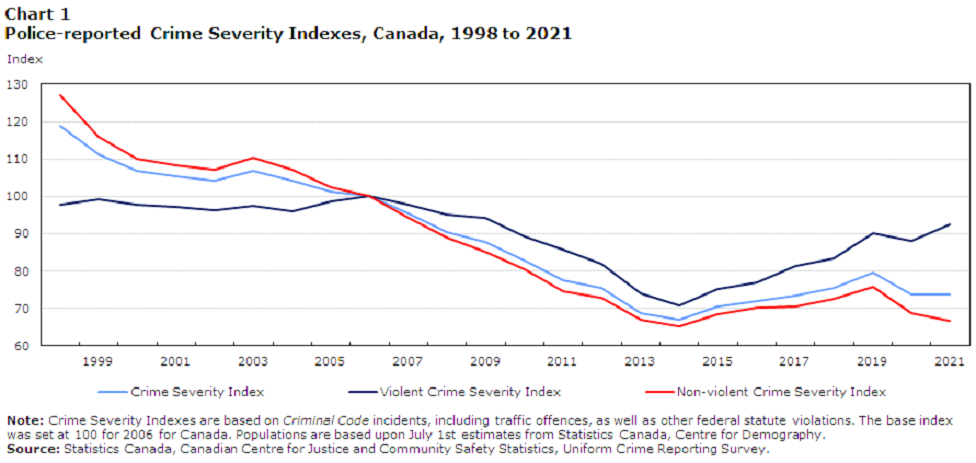
CSI Trends in Canada Graph 1998 2021
The graph shows that the overall percentage of the Canadian Crime Severity Index (CSI) saw a drop from 1998 to 2021. However, recent years have recorded a slight increase in the CSI, varying from 79.75 to 73.68 between 2019 and 2021.
Note that most of the data gathered in this post covers the years 2021 and 2022, since the Statistics Canada database usually has a lag of approximately 2 years in updating.
Another important point that must be mentioned is that after all the social ramifications and the worsening of the economic situation in Canada during the pandemic, safety indexes decreased across the country. Therefore, some information might not completely reflect reality by the end of 2023, the period in which this text was written.
However, this text still offers a good starting point for you to conduct a more detailed investigation on your own.
List of the Safest Cities in Canada:
- LaSalle - Ontario
- Quebec City - Quebec
- Ottawa - Ontario
- Trois-Rivières - Quebec
- Sherbrooke - Quebec
- Gatineau - Quebec
- Toronto - Ontario
- Barrie - Ontario
- Guelph - Ontario
- St. Catharines - Ontario
What are the 10 Safest Cities in Canada?
1 - LaSalle (Province of Ontario)
- Population: 32,721
- Crime Severity Index (CSI): 20.69
Aerial View of the Safest City in Canada, Lasalle
LaSalle, ON, tops the list of the safest cities in Canada, boasting an exceptionally low Crime Severity Index. With a CSI of 20.69, the city records a rate 72% below the national average.
LaSalle residents enjoy relatively high incomes and a low unemployment rate, fixed at 3%.
With over 40 km of paved trails and more than 100 acres of parkland, the city offers ample space for walking, running, or biking, all without safety concerns.
Additionally, LaSalle is home to the Night Markets at the Civic Centre, held on the last Sunday of May, June, July, and August. These events offer music, vendors, and a variety of culinary delights in a safe and pleasant environment.
2 - Quebec City (Province of Quebec)
- Crime Severity Index (CSI): 48.6
- Population: 733,156
The charming Quebec City, one of the most beautiful and safest in Canada, stands out for its low crime rate compared to other urban centers.
Its relatively low CSI score highlights the effectiveness of the city’s legal and judicial system, committed to maintaining safety and order.
The uniqueness of the province of Quebec in Canada lies in the predominant use of French by the local population, which contributes to strengthening an intense sense of community.
Encompassing a diverse population in terms of age, ethnicity, and culture, Quebec City is proud of its well-educated residents, many of whom hold post-secondary degrees (higher education).
Within Quebec City, several neighborhoods stand out as beloved by locals. One of them is Sainte-Foy-Sillery-Cap-Rouge, known for its quiet and family-friendly atmosphere, in addition to excellent educational institutions.
Another appreciated area is Montcalm, especially popular among professionals and young families, due to its charming architecture, delicious restaurants, and unique shops.
Quebec City is filled with national parks, offering a variety of places for hiking and outdoor activities. Moreover, it is a favorable region to find employment, featuring the lowest unemployment rate in the country. And, it is worth noting, the cost of living in Quebec is not excessively high.
For those looking for a safe and dynamic home, Quebec City represents the ideal combination of safety, community, and quality of life.
3 - Ottawa (Province of Ontario)
- Crime Severity Index (CSI): 50.2
- Population: 1,017,449
Ottawa is known for its safety and low crime rate, making it an ideal place to call home. Ottawa is one of the safest cities in Canada.
As a melting pot of ages, nationalities, and cultures, Ottawa has a diverse and highly educated population. These respectful and law-abiding residents contribute to the serene and friendly atmosphere of the city.
Westboro is a popular Ottawa neighborhood, known for its trendy shops, restaurants, and cafes, as well as its beautiful parks and outdoor spaces.
It is an ideal location for young families due to its low crime rate, excellent schools, and family-oriented community.
The Glebe, another popular district, is close to downtown Ottawa and has a rich history. It is a sought-after area for young professionals and students, offering a lively vibe, beautiful parks, and proximity to universities.
In Ottawa, you will find the perfect mix of safety, community, and quality of life.
4 - Trois-Rivières (Province of Quebec)
- Crime Severity Index (CSI): 52.3
- Population: 128,057
According to the Crime Severity Index, Trois-Rivières has a lower crime rate than other Canadian communities of similar size.
The low crime rate makes it one of the safest cities in Canada. The well-trained police force contributes to a sense of safety among residents.
Trois-Rivières, with its relatively low population density, is a quiet city that attracts both families and retirees, providing a charming atmosphere.
The city has several residential neighborhoods recognized for the safety and quality of life they offer. One of them is Saint-Louis-de-France, famous for its historical charm and welcoming environment, being a highly appreciated location.
Another notable neighborhood is Cap-de-la-Madeleine, situated along the south shore of the St. Lawrence River. Known for its stunning waterfront landscapes and low crime rates, this region attracts people with its natural beauty.
Cap-de-la-Madeleine is a family-oriented community, with excellent schools and solid community cohesion.
5 - Sherbrooke (Province of Quebec)
- Crime Severity Index (CSI): 52.6
- Population: 151,157
As one of the safest cities in Canada, Sherbrooke has a low Crime Severity Index score that sits below the national average. Although smaller in size compared to other Canadian cities, Sherbrooke’s demographic diversity nurtures a strong sense of community and social cohesion, which helps keep crime rates low.
Lennoxville, a popular neighborhood in Sherbrooke, is home to Bishop’s University, a small liberal arts college that attracts a young crowd. With a vibrant arts scene and a variety of restaurants, cafes, and shops, Lennoxville offers a lively atmosphere. Its reputation as a safe area makes it an ideal place for young people to live, study, and enjoy life in one of the safest cities in Canada.
The Sherbrooke University Hospital Centre is a leader in neuroscience and oncology research, with over 6,000 employees. The city is known for its historical buildings, one of the oldest golf courses in Canada, and a thriving craft beer scene.
6 - Gatineau (Province of Quebec)
- Crime Severity Index (CSI): 53.3
- Population: 291,041
Gatineau earns its reputation as one of the safest cities in Canada thanks to its low Crime Severity Index score, which is below the national average. Its diverse population, influenced by its proximity to Montreal and Ottawa, encompasses various ages, races, and cultural backgrounds. Living in Gatineau is also relatively more affordable compared to larger neighboring cities.
Ottawa and Gatineau are close neighbors, separated by the Ottawa River. Residents often commute between the two cities, benefiting from shared amenities such as public transportation and hospitals.
With Ottawa being predominantly English-speaking and Gatineau predominantly French-speaking, the region offers a comfortable environment for Canadians of different linguistic backgrounds.
Aylmer, a much-loved neighborhood, offers a family-friendly atmosphere and a lower crime rate compared to other areas in Gatineau. Hull, located downtown, is popular among young people for its vibrant restaurant scene, nightlife, and cultural events. It is an attractive area for young residents, offering a mix of affordable apartments and trendy condos.
7 - Toronto (Province of Ontario)
- Crime Severity Index (CSI): 56.7
- Population: 2,794,396
Surprisingly, Toronto, Canada’s largest city, ranks as one of the safest in the country. With a considerably low Crime Severity Index compared to other major cities like Montreal (1,791,508 inhabitants) and Calgary (1,611,000 inhabitants), Toronto stands out as the safest metropolis in the country.
Located on the shores of Lake Ontario and home to the Toronto Maple Leafs, the city is recognized as one of the most culturally diverse in Canada. It has become a popular destination for Canadians and foreigners looking to be part of the country.
Toronto is known for its vast demographic diversity, making it welcoming for everyone. Neighborhoods like North York, Scarborough, and Etobicoke are ideal for families seeking a safe and welcoming environment, offering excellent schools, parks, and community centers to promote family flourishing.
On the other hand, neighborhoods like Downtown, Queen West, and the Annex are preferred by young professionals and students, providing a vibrant nightlife, trendy restaurants, and an exciting urban lifestyle, all while maintaining a safe and secure environment. Toronto stands out as the top choice among the safest cities in Canada.
Despite leading in safety among the five largest cities in the country, Toronto is also the most expensive. A higher income is required, and potential residents must be prepared for the costs associated with buying or renting in the city.
8 - Barrie (Province of Ontario)
- Crime Severity Index (CSI): 57.7
- Population: 154,676
Located just 90 kilometers from Toronto, Barrie provides a peaceful and safe alternative to the fast-paced life of the big city.
With a Crime Severity Index below the national average, residents can enjoy peace of mind, knowing that safety is a priority in this charming city.
Barrie is a rapidly growing municipality in Ontario, with a technology-driven economy. Although the cost of living is higher than the national average, it provides a safe and prosperous environment for its inhabitants.
Popular family neighborhoods like Allandale, Holly, and Painswick offer excellent schools, parks, and community centers, creating the ideal setting for family life. These areas have a warm community atmosphere, ensuring families feel at home.
For young adults, downtown Barrie is the place to be. With its modern bars, restaurants, and shops, this vibrant area provides an ideal environment to socialize and enjoy the city’s attractions.
Discover Barrie as an attractive option among the safest cities in Canada, offering a serene lifestyle without compromising on safety or entertainment options.
9 - Guelph (Province of Ontario)
- Crime Severity Index (CSI): 58.2
- Population: 144,356
Guelph is not only a safe place to reside but also a welcoming and dynamic community. With a Crime Severity Index below the national average, residents enjoy a safe environment in this diverse city.
Known as “The Royal City”, Guelph was named in honor of the British royal family.
Families searching for the ideal neighborhood will find satisfaction in communities like Westminster Woods, Kortright Hills, or Grange Hill East. These regions provide a friendly and safe atmosphere, ideal for raising a family.
For young people seeking a vibrant lifestyle, downtown Guelph is an excellent choice. With its modern cafes, restaurants, and bars, this area offers a lively atmosphere.
Downtown Guelph offers various renting and buying opportunities, making it an ideal place for those just starting out. Enjoy the perfect balance between safety and liveliness in Guelph, recognized as one of the safest cities in Canada.
10 - St. Catharines (Province of Ontario)
- Crime Severity Index (CSI): 62.1
- Population: 140,370
St. Catharines is a welcoming and safe city, with a Crime Severity Index below the national average. It stands out for its strong sense of community, making it an attractive location for both families and young people.
For families, neighborhoods like Glenridge, Facer, and Western Hill offer great options, recognized for their excellent schools, parks, and activity centers.
As for young people looking for a vibrant atmosphere, downtown St. Catharines and St. Paul Street are ideal.
These modern areas provide a bustling nightlife, charming cafes, restaurants, and entertainment venues.
Discover the charm and safety of St. Catharines, one of the safest cities in Canada, and enjoy the perfect combination of tranquility and excitement.
Frequently Asked Questions about Safety in Canada
What is the most suitable city in Canada for newly arrived immigrants to live in?
The ideal city for immigrants is one that can balance long-term career opportunities with the cost of living. There is no point in moving to the safest place in the world if there are no good job opportunities.
It is important to stop believing the fairy tale sold on the internet that being happy cleaning or working at a McDonald’s abroad is a guarantee of a comfortable life. These professions have not been enough to cover expenses in Canada for a long time.
If you can combine a peaceful life and a dream job in the same package, consider yourself lucky, as this is not the reality for the majority here.
Living in a large urban center because of opportunities also has its cost. It might mean slightly less safety, but nothing comparable to Brazil.
Is there any dangerous city in Canada?
Of course! That is just another fairy tale the internet tells you. Without wanting to sound repetitive, insecurity does exist in some places in Canada, but there is no way to compare Canada with Brazil.
The crime considered relevant in the country is limited to thefts and car break-ins, theft of Amazon packages left at doors, and occasional house break-ins, along with a significantly lower number of homicides recorded in some cities considered unsafe.
Overall, the proportion of homicides per 1000 inhabitants in large centers is often less than a tenth of what we see in large centers in Brazil with similar absolute populations.
Common things in Brazil, such as armed robberies, violent crimes, and robberies resulting in death, are not part of everyday Canadian life, although this is changing.
In most of Canada, it is still possible to walk alone at night using the latest iPhone without fearing for your life, even on streets where you would never venture in Brazil.
Is the police force effective in combating crime in Canada?
Yes, I would say they are even quite heavy-handed. I have witnessed many incidents of violence during police stops in Canada, and believe me, police in Brazil might not be as bad as you think.
Perhaps this is one of the reasons why things here work in a more disciplined manner. In short, either you walk the line, or they point a gun at your head and throw you to the ground. The order for dangerous criminals is to shoot first and ask questions later.
However, I also observe a lack of flexibility in some actions. The impression I get is that they get very nervous over small things. Just look at the number of police cars and fire trucks that arrive for a low-severity incident. It looks like BOPE is going up a hill in Rio de Janeiro.
The increase in crime rates is still somewhat new for Canadian police officers, for whom the highlight of their careers in many cities has been dealing with domestic violence issues.
Final thoughts
I believe this list might cause discomfort or even disappointment for some people, but as I mentioned at the beginning of the text, it does not reflect my personal impressions; it is data from the Canadian government’s statistical system.
As for the total reliability of this system? I cannot say for sure.
After stating that Toronto is safer than Montreal, I can admit that perhaps I am inclined to give an opinion on what the government really considers safe in a city.
Among all the listed cities, I have visited five of them: Quebec City, Ottawa, Trois-Rivières, Gatineau, and Toronto. While I shouldn’t base this on my personal opinion, of all of them, Toronto was the one that gave me the least sense of safety.
Maybe it’s because I didn’t explore the right places. Who knows?
My suggestion will always be: if you have the chance, see it with your own eyes! Nothing replaces your personal impressions, especially when the decision to move is entirely yours.
A good example of what I’m saying happened when I visited Vancouver in 2022, something that completely altered my perception of the city, especially in terms of safety, beauty, and cultural wealth.
Today, I even better understand the reason why no city in British Columbia (the province that houses the city of Vancouver) was mentioned in the list. But that’s a story for another post.
Lists are just lists, after all.
With that, I’ll sign off for today. Don’t forget to subscribe to our newsletter to receive weekly updates on how to prepare for this journey we affectionately call immigration.
See you in the next post! 😀

Marco Vasconcelos
Brazilian, webmaster, and e-commerce specialist living in Montreal since 2018. Founder of Você no Quebec, sharing practical guides, housing tips, and real-life experiences in the province to help Brazilian and international newcomers transition smoothly.
Read more about Marco →