Food Banks in Quebec: A Practical Guide for Newcomers
| Updated in August 2026. The situation has gotten much worse since the first version of this post, and this is important for you to know before relying on this feature. In 2025, the Banques alimentaires du Québec network responded to 3,119,842 requests for food aid per month, a new record. Demand has grown 61% since 2019, and today one in five Quebecers lives in a situation of food insecurity. The network's own projections point to 3.9 million monthly requests by 2028. In practice: food banks continue to exist and continue to help, but they are overloaded. Arrive early, respect the attendance rules of each organization and do not count on them as your main subsistence plan. |
What are food banks?
Many newly arrived immigrants may face financial challenges as they adapt to a new country, especially in their first year. This can include difficulties finding a job, dealing with accommodation expenses such as rental property, furniture and even the cost of appropriate clothing to adapt to Canada’s climate. In this sense, food banks can be a vital source of help for many immigrants.
Additionally, Les bénévoles (as they are called in Quebec) provide food and also offer additional services that may be useful for immigrants. For example, CACI Montréal offers a variety of programs, including counseling and employability services, that can help newly arrived immigrants connect with resources and opportunities in their new community.
Read also: “Quebec for Brazilian newcomers: Tips on local culture”
To access these services, newly arrived immigrants can contact these organizations directly or seek information from local immigrant support entities. Immigrant support organizations can help newcomers connect with needed resources like food banks and other services.
Breaking Taboos
Starting from scratch, this is something that many immigrants like me only realize when they transition between countries and suffer from the most common shocks, including culture, language and finally, currency exchange.
And a good exercise to test your newcomer nerves is certainly your first trip to the supermarket. You will soon notice that items such as meat, milk, cheese and some fruits and vegetables that you used to buy at relatively affordable prices in Brazil, even in times of high inflation, will not be so easy to digest when the bill to pay comes in Canadian dollars (practically four times the value of the real).
For those who don’t know my story, I’ll be brief. I arrived in Quebec as an international student in 2018, accompanied by my wife and two daughters and, like any self-respecting expatriate, I went through every type of experience you can imagine in the frozen lands of the north.
It also goes without saying that this adventure that we affectionately call immigration has a price that not everyone is willing to pay. And as such, this is not a project for amateurs either. It requires complex financial planning so that you are able to maintain your family with a minimum of dignity for up to a year, so keep in mind that this plan must always include the worst-case scenario in order to avoid some well-known frustrations of immigrant life.
Read also: “What do I need to study and work in Canada”
And why am I telling this well-worn immigrant saga? Simple, it’s always good to give a reality check to those who want to start over, but haven’t yet broken some taboos in this process, such as resorting to services aimed at low-income people. In Brazil, unless you are in a food risk situation or earn just over the minimum wage, it is unlikely that you would be a candidate for any type of humanitarian aid or have access to government social programs. And let’s agree on one thing, if you are a candidate for Canadian immigration, you probably have a bullet to get here.
Who can be considered a low-income person in Canada?
In Canada, the concept of “low income” varies according to several factors, such as the region where the person lives and the size of the family. However, the Canadian government uses a measure called Low-income measure, after tax (LIM-AT) to determine eligibility for social programs.
According to 2019 baseline data, LIM-AT varies by family size and region, but on average, a family of four in the province of Quebec is considered low-income if the family’s annual after-tax (net) income is less than CAD 52,000. However, it is important to highlight that this is just a reference measure and that the government takes into account other socioeconomic factors to determine eligibility for social programs.
Now you might be thinking, being low income in Canada isn’t a bad deal. Well, that is until you discover that the hole is much lower, especially now that Canada is going through one of its biggest recessions in the last 10 years.
When I arrived in Quebec in 2018, this amount was less than CAD 50 thousand, certainly in other times. In practice, a net family income of CAD 52 thousand per year would be the equivalent of just over a salary of CAD 13 per hour for each partner, which is lower than the minimum wage in Quebec, which is CAD 14.25 per hour.
Another important component in this scenario was COVID-19, as a much smaller portion of Canadians were users of food banks before 2020. After the pandemic left its mark and the food price inflation rate soared, this number grew consistently even among middle-class families.
Read also: “How to Find Cheaper Rentals in Montreal”
Have you now seen that it is not difficult to be considered low income in Canada? Well, now that you know this, don’t even think twice about qualifying for food aid programs as soon as you arrive, as the grocery bill can quickly deplete your financial reserves. I would say, apply to as many as you can. They were a great help with my budget until I graduated and was able to return to the job market, something that took over a year.
How to access food banks in the province of Quebec?
If you are in need of food in Quebec, there are several food bank organizations that can help. Below are some steps you can follow to utilize food banks in Quebec:
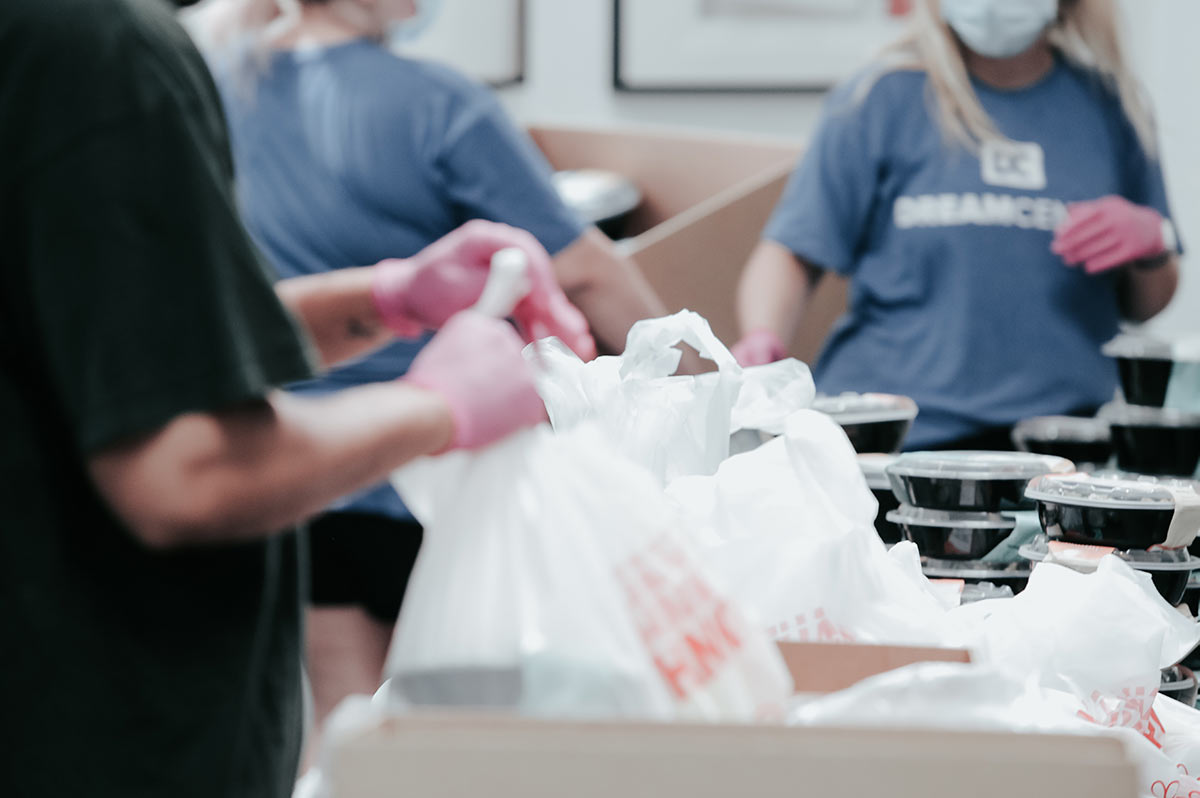
Food bank. Photo: Joel Muniz
- Find a food bank near you: The first step is to find a food bank close to your home. The Food Banks of Quebec directory lists organizations in different regions of the province. You can also search for local community groups and assistance services.
- Check Eligibility Requirements: Each food bank organization may have its own eligibility requirements. Generally, food banks require you to provide some basic information, such as your family size and income. Some organizations may require you to present proof of Quebec residency and valid identification or even some proof of income.
- Apply directly to the food bank: After checking eligibility requirements, you can contact the food bank to schedule a visit or go directly to the location. The vast majority of food banks require a very affordable registration fee (like an annual fee) to provide a card.
- Pick up the food: When visiting the food bank, present your card to receive a pre-selected basket or bag of food that is distributed at a very low cost (or possibly free). Generally, the foods available include non-perishable products such as rice, pasta, canned goods, as well as fresh fruits and vegetables and breads. Some organizations may ask you to schedule an appointment before picking up the food, while others may allow you to visit the food bank at specific times (Generally once a week).**
Where do these foods come from?
Food offered by Quebec food banks generally comes from a variety of sources, including food donations from companies and individuals, as well as government programs supporting agriculture and food.
These food banks work in partnership with food retail companies, local agricultural producers, and food distributors to collect food that has not been sold or is close to its expiration date but is still safe for human consumption.
They also collect non-perishable foods, such as canned goods and dry goods, through food donations at fundraisers and charity events. After collection, this food is classified and distributed to organizations that work with vulnerable people in Quebec.
Tips for using food banks in Quebec
- Avoid long distances: Avoid registering with food banks whose location is very far from your address. If you have to travel for more than 1 hour on public transport to get to a bank, there is a high chance that your registration will be rejected. In some cases, it is possible to use the address of your educational institution as a reference, if you are a student. In my case it worked.
- Arrive early: Pay attention to opening times. I know this is something that not everyone can do, but keep in mind that latecomers will typically be left with leftover baskets or in some cases, may even return empty-handed.
- Be prepared to carry weight: Bring your own bags, backpacks and shopping cart. In some banks it is possible to get refrigerated foods such as milk, cheese, yogurt and even meat, but they only allow you to take them if you have a thermal bag or cooler to carry with you.
- Don’t frown at expiration dates: Technically, foods that are past their expiration date still have a safe margin of consumption. Food banks in Canada follow very strict rules for distributing food, so go with an open mind and body.
- Don’t limit yourself to just one: As already mentioned, banks vary a lot, so you may not be able to find an ideal package that meets your needs.
- Only take what you are actually going to consume: Some food banks provide packages that may vary according to the time of year or on special dates, delivering baskets full of a certain product, so don’t abuse it if you aren’t going to consume it. Don’t be shy about saying it’s too much food for you. Remember, there will always be someone who needs it more than you.
 Bonus tip! Some organizations let you choose products while respecting the limits of your selected package. I used this type of service for a while at GEMO. In 2019, when I still used the service, I paid around CAD 15 for a weekly basket that would easily have cost more than CAD 100 at a supermarket such as Walmart. Bonus tip! Some organizations let you choose products while respecting the limits of your selected package. I used this type of service for a while at GEMO. In 2019, when I still used the service, I paid around CAD 15 for a weekly basket that would easily have cost more than CAD 100 at a supermarket such as Walmart. |
Final thoughts
It is important to make it clear that most of the people involved in social food distribution work voluntarily or receive below-average wages. Many of them are just there trying, in some way, to make a difference in the life of someone less fortunate.
This is a continuous cycle, which must be practiced by those who once benefited, like me and many of my friends, going from user to volunteer. Me, my wife and daughters have already left our small contributions at times and, whenever we can, we try to repay this help in some way in possible community activities.
One of the initiatives that I always make a point of mentioning is the wonderful support work for Portuguese-speaking immigrants provided by Le Center d’aide à la Famille - CAF in Montreal. This space was once a welcome home for many recently arrived Brazilians looking for a bit of the human warmth of their countrymen. I can say that it was fundamental for my teenage daughters at a difficult time of adaptation.
My last piece of advice is: don’t be afraid to overcome another big taboo about life abroad, that of escaping your communities. You will discover that there are Brazilians in Quebec willing to offer hospitality without asking for anything in return.
The Você no Quebec project was one of the ways I found to help as many people as possible, so if you can help by sharing the texts with those in need, you will be helping our community too.
To better understand the first steps of adaptation, also read our guide on important topics for newcomers to Quebec.
Well, that’s what I had to say today. If you want more tips like these, sign up for our newsletter to receive updates about life in Canada, especially in Quebec and Montreal.
See you in the next post! 😉

Marco Vasconcelos
Brazilian, webmaster, and e-commerce specialist living in Montreal since 2018. Founder of Você no Quebec, sharing practical guides, housing tips, and real-life experiences in the province to help Brazilian and international newcomers transition smoothly.
Read more about Marco →