

How to Calculate Your Net Salary in Canada
Editorial review: August 2026. Values, rates, exchange rate and tax rules change. The examples help with planning, but do not replace a current simulation or professional guidance for your case.
Why so many Canadian payroll deductions?
In Canada, your employer makes certain deductions from your salary before it can go into your account. Some of these paycheck deductions, such as income taxes, go toward financing public systems, while others can be used to provide financial assistance at certain stages of life, such as during periods of unemployment, maternity and paternity leave, or retirement.
In this case, your pay stub must include full details of the payroll deductions that were made by your employer.
Read also: “20 frequently asked questions about working in Canada”
What is the base date for receiving your salary in Canada?
Unlike Brazil, Canadian employers enjoy much greater flexibility in defining their base payment dates, as most employment contracts are governed by private agreements, with the exception of some special categories governed by unions. Therefore, it is common for employees in Canada to receive payments on a weekly, fortnightly or monthly basis.
Since what matters is your hourly wage and the number of hours you work per week (generally 37.5 hours), your earnings are quite predictable. For this reason, Canadian companies have a culture of always informing the annual salary in their job offers to simplify the process.
You can quickly do a calculation to obtain the necessary salary fractions using the following formula: (Hourly salary x Total hours worked in the week x Total weeks in the year). For example: $16 CAD per hour x 37.5 hours x 52 weeks = Gross Salary of $31,200 CAD per year.
Read also: “How much does it cost to live in Canada in 2026?”
What does a pay stub or salary slip look like in Canada?
A pay stub, also known as a pay stub or Paycheck (for English speakers) or Chèque de paye (for those living in Quebec), is a record of your employment earnings. In Canada, permanent employees receive a pay stub for each pay period, whether you are paid weekly, fortnightly, fortnightly or monthly.
For each salary payment you receive, the accompanying pay stub will show how that amount was calculated, including payroll deductions made by your employer. Your pay stub can be in paper or digital format and can be given to you in person, emailed to you, or stored in an online portal that employees can access.
A pay stub is different from a paycheck, which is the actual payment of wages in the form of a physical check. Many Canadian employers also ask employees to sign up for direct deposit, in which case you will receive your salary transferred directly to your bank account instead of by check.
To do this, your employee usually asks you to present the popular Void Check. You can ask your bank manager for it or simply download it if you use an internet banking application to access your account. See an example of Void Check below.
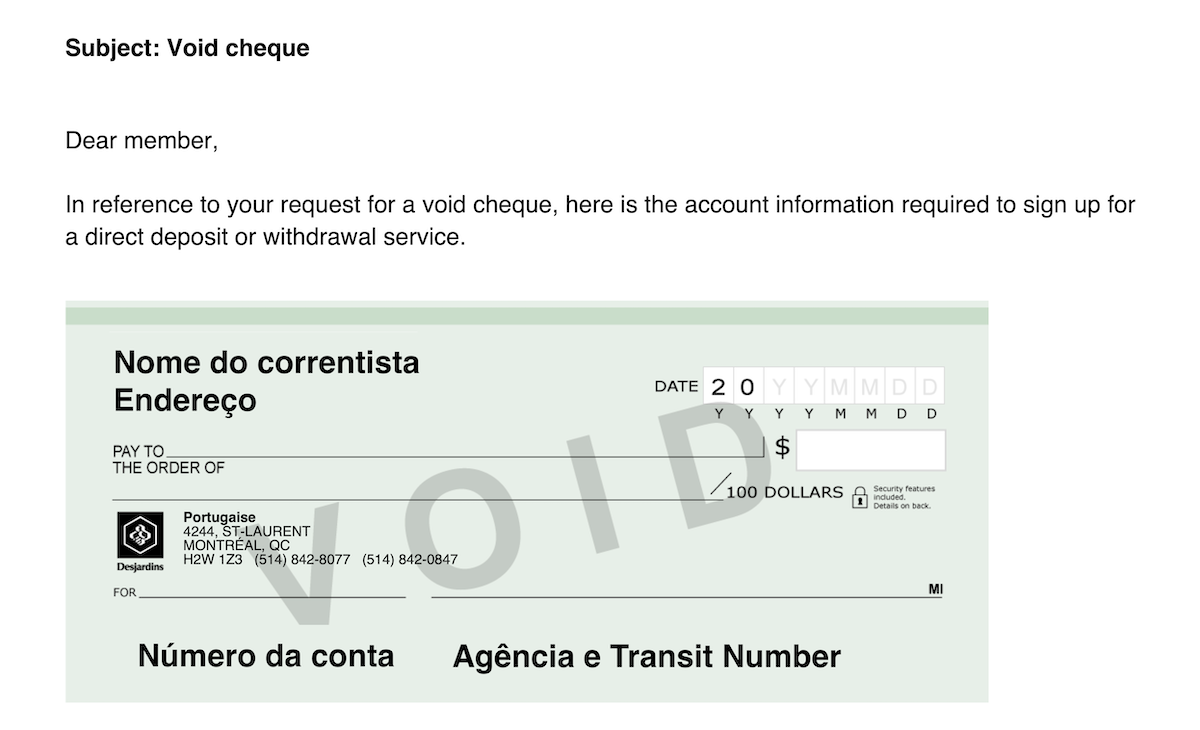
Void Check Example - Source: Banco Desjardins
It seems pretty silly at first to have to show this document instead of simply providing your account details to your employer, but this is a cultural thing in Canada, so just accept it. Void Check will act as a type of authorization for your employer to deposit your salary into your account.
What does your Canadian pay stub include?
As a newcomer to Canada, it’s important to know what your pay stub includes and how you should read it. Although pay stubs from different companies may look a little different, they typically include the same information. Here’s an overview of the information your pay stub provides:
- Your name, address and your Social Security Number (SIN)
- Employee identification number (Your registration number), if applicable.
- Pay date, or the date you receive your salary or wages for the period.
- Pay period, which is the period for which you are being paid (usually two weeks, 15 days, or a month).
- Gross earnings or your income for that pay period before taxes and deductions.
- Deductions for the pay period such as income tax deducted at source, etc.
- Net pay for the pay period, which will be your take-home pay after taxes and deductions. (NET PAY)
- Gross pay and annual deductions.
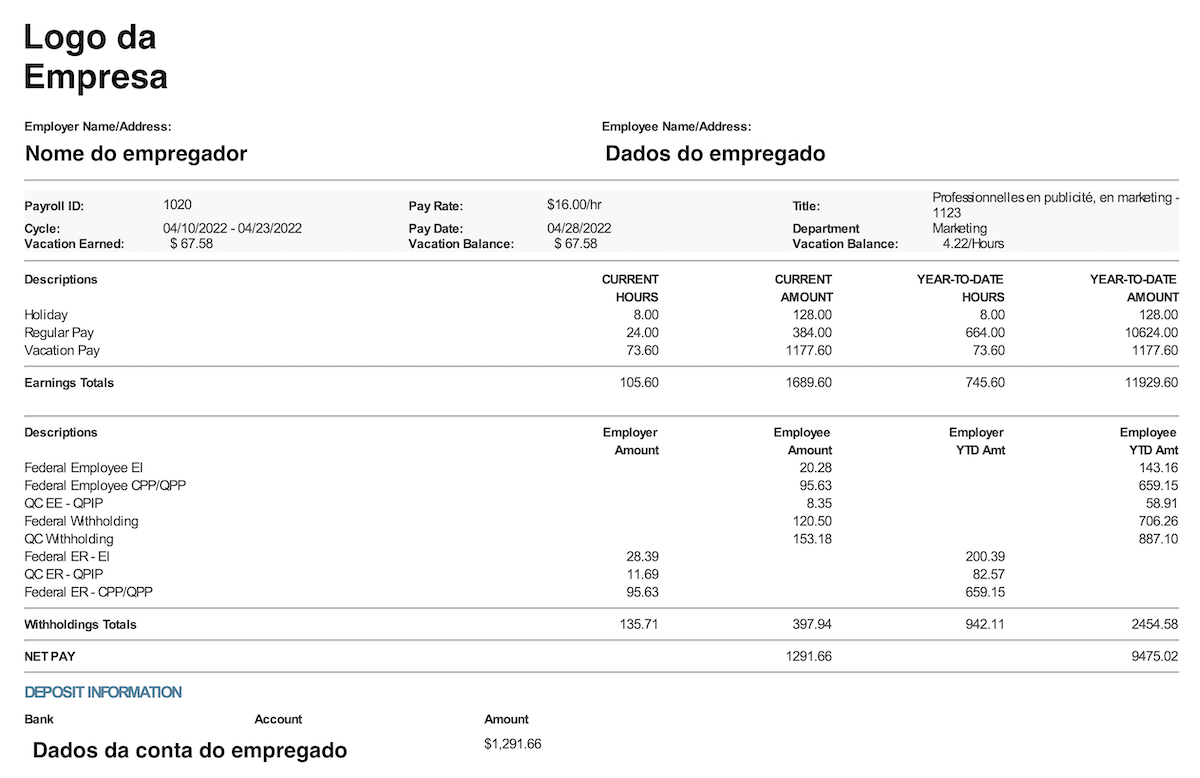
Example of Canadian Pay Check (Base salary $16CAD hour)
Read also: “How to obtain a Social Security Number (SIN) when arriving in Canada: Complete guide”
Your salary in Canada varies depending on the province where you work
Well, another Canadian prank. In Canada, tax deductions vary depending on the province in which you work, something that does not occur in Brazil.
To illustrate this more clearly, I will use as a reference the official Canadian Revenue Agency payroll deduction calculator. In this example, I will demonstrate using a closed number, salary of $100,000 per year, to give you a quick idea of the Canadian lion’s bite.
Notice! The tables and examples in this post were revised in August 2026 and use the official parameters for the 2026 fiscal year. As these values are readjusted every January 1st (and the minimum wage on May 1st), always check the official source before closing any important account, I left the links throughout the text.
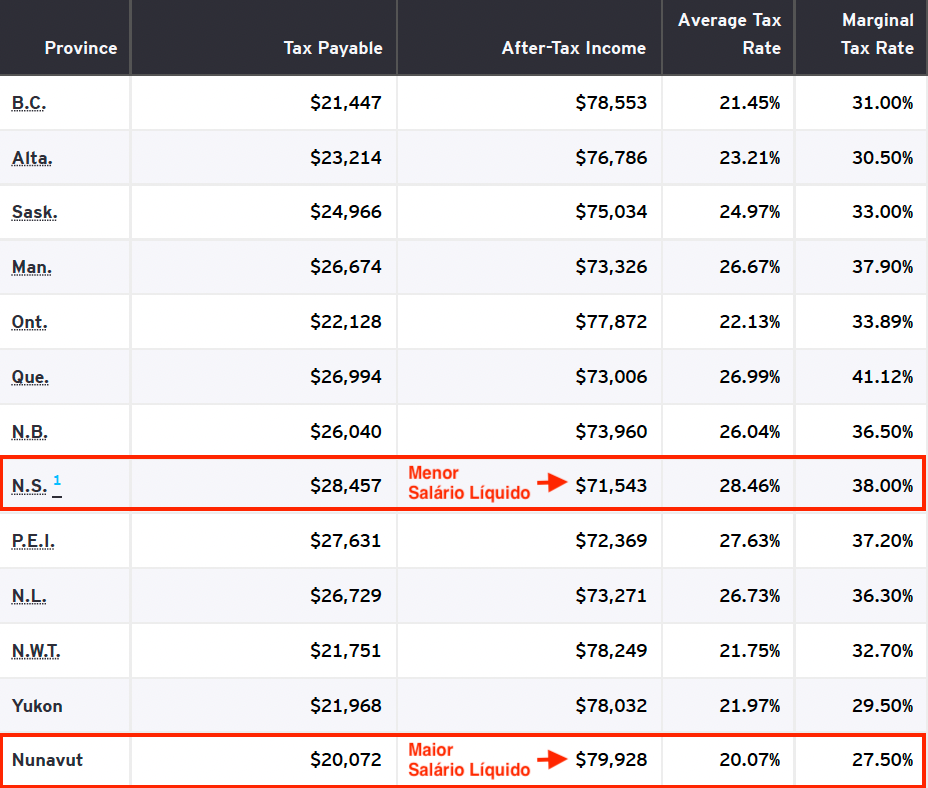
Salary deductions by province in Canada (base salary of 100 thousand per year). The image values reflect the year in which it was produced; Redo the calculation with current rates before making a financial decision.
First place in terms of bite size went to the province of Nova Scotia. On the other hand, if you are a strong type, willing to live most of the time under the ice in the company of Eskimos (called the first nation) and polar bears, the salary in the province of Nunavut may even compensate for the hardship.
Payroll Deductions in Canada
Payroll deductions may come as a surprise to some newcomers, especially those who come from countries like Brazil, where the form of taxation has many other peculiarities.
Being smart about how payroll deductions work is highly recommended for newcomers, as it can avoid poor financial planning in the first few months of employment.
It’s quite understandable to be excited when you receive a salary offer to work in Canada that is in the region of $80,000 per year. In fact, this is a very common feeling not only among Brazilians.
Not realizing exactly how much goes into your pocket is, in fact, a very common mistake made by many newcomers who don’t do the calculation of the Canadian cost of living versus net income. So, to demystify this Pandora’s box called tax in Canada, I will demonstrate the calculation and deductions using a very popular tool available on the website Talent.com.
Read also: “How much does it cost to live in Canada in 2026?”
In this example, we will simulate a salary of $74,600 CAD per year in the province of Quebec. Later I will explain why I used this value (spoiler: it is exactly the RRQ earnings ceiling in 2026). This simulator uses parameters such as 37.5 hours of work per week and two weeks’ vacation.
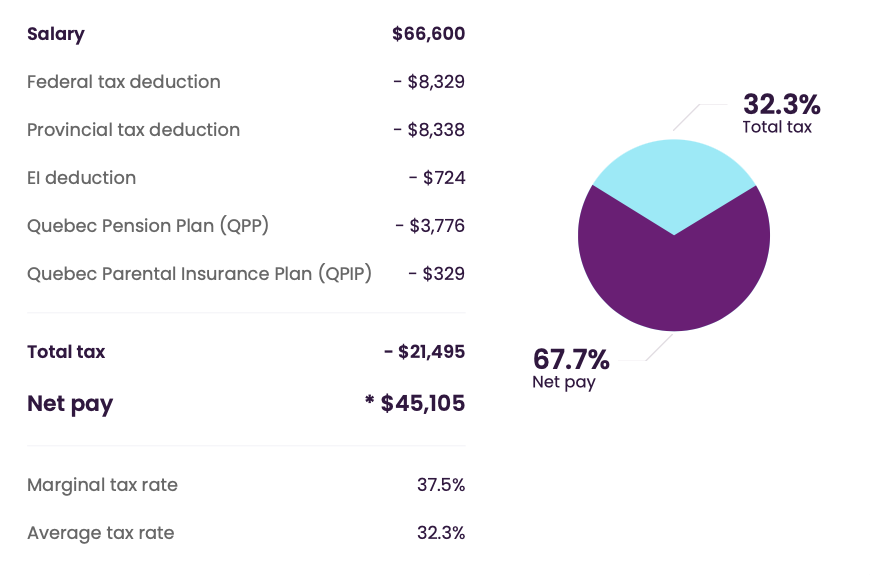
Payroll deductions Canada - Quebec - Source: Talent.com (The screenshots in this post are illustrative and were taken in previous years, they help you understand where each item appears on the payslip. The values that apply are those described in the text, updated for 2026.)
The most common payroll deductions in Canada include:
- Contributions to Canada Pension Plan (CPP)
- Quebec Pension Plan (QPP)
- Employment Insurance (EI) Premiums
- Income tax deductions.
In some cases, your pay stub may also include payroll deductions, such as contributions to the group pension plan or group retirement plan, union dues, or premiums for fringe benefits.
Notice! The values listed in this simulator are only estimates, as to make the exact calculation it would be necessary to inform many other variables such as number of hours worked per week, weeks of vacation and additional deductions. If you have some knowledge of tax accounting and Canadian laws governing payrolls, the most recommended thing is to use the tools made available by the government.
- Federal Government Simulator
- [Quebec Government Simulator](https://entreprises.revenuquebec.ca/EntNA/SX/SX03/SX03. WebRAS/SX03A4WA/Home/RenseignementsGeneraux)
Canada Pension Plan (CPP) or Quebec Pension Plan (QPP)
What is the Canada Pension Plan (CPP)?
The Canada Pension Plan is a government-administered plan that provides a taxable pension to replace part of your income after retirement. It is funded through contributions made by eligible employees, employers and the self-employed. Quebec has its own pension plan known as Pension Plan de Quebec (QPP), and employers and workers must contribute to the QPP instead of the CPP.
Read also: “10 Frequently Asked Questions about Income Tax Returns in Canada”
Who needs to make contributions to CPP or QPP?
Employers are required by law to deduct CPP contributions (QPP if you are in Quebec) from your salary if you meet the following conditions:
- You are in a pensionable job for all or part of the year.
- You are between 18 and 69 years old, even if you have already started receiving a CPP or QPP pension. You can, however, choose to stop contributing when you reach 65 years of age.
- You are not considered disabled as defined by CPP or QPP.
Your employer must match your contribution and remit the full amount to the government. Self-employed individuals with a net income (from their business and employment, if any) of more than $3,500 CAD are also required to contribute to the CPP or QPP.
How employers calculate your CPP contribution
Every year, the government sets a maximum pensionable annual earnings limit and contribution rate for employees and employers. In 2026, the numbers in Quebec are these:
- Allowable Earnings Cap (MGA): $74,600 CAD (was $71,300 in 2025)
- Basic exemption: $3,500 CAD (not changed in years)
- Employee contribution rate: 6.30% (down from 6.40% in 2025)
- Maximum annual contribution: $4,479.30 CAD
This means that if your annual income in Quebec is equal to or greater than $74,600 CAD, you will contribute 6.30% over the range between $3,500 and $74,600, capped at $4,479.30 for the year. From then on, stop discounting.
Attention to the supplementary regime: since the reform of the RRQ there is a second band. On earnings between $74,600 and $85,000 CAD (so-called MSGA), an extra contribution of 4.00% is applicable for both the employee and the employer. In other words, those who earn above the ceiling continue to see an RRQ discount on their pay slip, just smaller and under a different heading.
The employer is required to match your contribution and pass the total to the government.
See another calculation example. To reproduce it with current values, use the official CRA calculator.
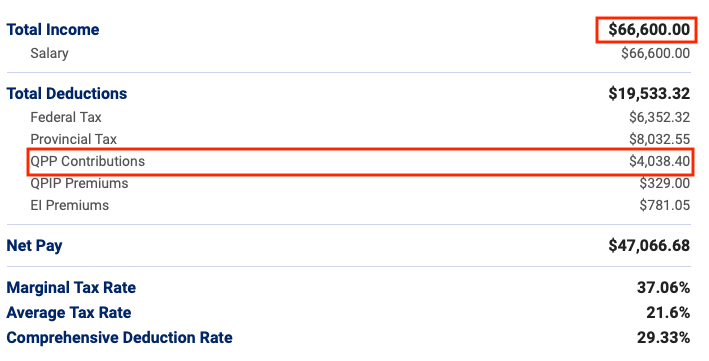
Quebec government deductions and QPP. The values displayed reflect the period in which the simulation was carried out.
When do you start receiving CPP benefits?
The standard age to start receiving the CPP retirement pension is 65 years old, but you can choose to start it from the age of 60 or even 70 years old. The earlier you choose to start receiving your pension, the lower the monthly amount will be. The maximum monthly amount you can receive reaches age 70, so there is no benefit in waiting beyond that.
In addition to a retirement pension, the CPP also provides several other benefits such as the post-retirement benefit, disability pension, child benefit, survivor’s pension, and death benefit.
How much can you receive from your Canadian Retirement Pension (CPP)?
The CPP retirement pension you receive will depend on the age at which you start receiving your pension, the number of years you have contributed to the plan, and your average pensionable earnings over your working life.
For 2026, the maximum monthly amount you can receive in Quebec if you start your pension at age 65 is $1,507.65 CAD (considering the supplementary regime; just for the basic regime, $1,441.25). Your situation will determine how much you receive up to the maximum. However, the amount you are entitled to may be less than the maximum depending on your specific situation, such as if you join the workforce late, move to Canada mid-career, or choose to retire early.
Employment Insurance in Canada (EI)
What is Employment Insurance in Canada?
EI guarantees all or part of your employment earnings and provides temporary financial assistance to eligible individuals who have lost their jobs or are unable to work, as long as they meet certain predefined criteria.
Who needs to make contributions to EI?
Your employer will deduct EI premiums from your wages if your employment is insurable. There is no age limit for EI contributions. Your employer is required to pay 1.4 times your contribution and remit the full amount to the government. Self-employed individuals can also enroll in the EI program to qualify for special EI benefits.
Quebec has a separate Quebec Parental Insurance Plan (QPIP/RQAP), so employers deduct contributions from your pay and federal employment insurance premiums are adjusted. Rates change periodically; Check the official table for the current year.
What does unemployment insurance cover in Canada?
Regular EI benefits may provide temporary financial assistance if:
- You lose your job through no fault of your own, such as due to layoffs or seasonality in worker demand.
- You can demonstrate that you are capable and willing to work.
- You are actively looking for a job but are unable to find work.
- You were out of work and paid for at least seven consecutive days during the year.
- You have accumulated the required number of insurable employment hours in the last year or since the start of your last EI claim, whichever is less.
You will not be eligible for EI benefits if you voluntarily leave your job without cause, are fired for misconduct or for participating in a labor dispute, or are on leave to make up for overtime you have already worked.
Other benefits of EI include:
- EI Sickness Benefits, if you are temporarily unable to work for medical reasons.
- Maternity and parental benefits for people who are out of work because they are pregnant, have recently given birth, or are caring for their newborn or adopted child.
- EI Care Benefits, if you are off work to care for an injured or seriously ill person or someone who needs end-of-life care.
How employers calculate your EI premium
The government sets EI premium rates and limits for maximum insurable earnings each year. In 2026, for those working in Quebec, the employee rate is 1.30% (was 1.31% in 2025) and the maximum insurable compensation is $68,900 CAD (was $65,700).
This means that if your annual insurable income is $68,900 or more, you will pay $68,900 × 1.30% = $895.70 CAD in EI for the year. The employer contributes 1.4 times this amount.
Why is the rate in Quebec lower than the rest of Canada? Because the province pays maternity, paternity and adoption benefits through RQAP, not EI. In compensation, you have a separate RQAP deduction on your pay stub: in 2026 the employee rate is 0.430% on an insurable maximum of $103,000 CAD, which works out to $442.90 CAD per year.
How much can you get from Employment Insurance?
The amount you can expect to receive from EI varies depending on your insurable earnings and the unemployment rate in your area. In most cases, EI benefits are calculated at 55% of your average weekly insurance earnings, up to a maximum limit. With the maximum insurable amount of $68,900 in 2026, the benefit cap is around $729 CAD per week.
The unemployment rate in your area also determines how long you can receive EI. Typically, this duration varies from 14 to 45 weeks.
Income tax deduction
Another payroll deduction you’ll find on your pay stub is income tax. In Canada, your employer is responsible for deducting income tax at source (directly from your paycheck) and remitting it to the government.
Why do I need to pay income tax in Canada?
Individuals and businesses are legally required to pay taxes to finance the continued operation and improvement of publicly funded services. Income taxes, as well as indirect taxes (such as Goods and Services Tax or Harmonized Sales Tax) that you pay fund most public systems in Canada, including the healthcare system, school system, roads and highways, as well as newcomer settlement services.
Read also: “How does the school system work in Quebec?”
How much income tax will be deducted from my salary in Canada?
The income tax deducted from your salary will depend on your income. The federal and provincial governments have separate tax rates for each year, and your total income tax liability will depend on the province you live in and your annual earnings as shown at the beginning of the post.
| Faixa federal (2026) | Alíquota |
|---|---|
| até $58.523 | 14,00% |
| $58.524 a $117.045 | 20,50% |
| $117.046 a $181.440 | 26,00% |
| $181.441 a $258.482 | 29,00% |
| acima de $258.482 | 33,00% |
Federal income tax rates in Canada, tax year 2026. The basic personal amount exempt in federal is $16,452 CAD. Those who live in Quebec are still entitled to a 16.5% reduction on federal tax.
| Faixa de Quebec (2026) | Alíquota |
|---|---|
| até $54.345 | 14,00% |
| $54.346 a $108.680 | 19,00% |
| $108.681 a $132.245 | 24,00% |
| acima de $132.245 | 25,75% |
Quebec provincial income tax rates, tax year 2026. The basic personal amount exempt in Quebec is $17,183 CAD.
If your annual earnings are less than the total amount on your Personal Tax Credits Statement or form TD1, you can ask your employer to reduce your deductions or get a tax refund when you file your income tax return (ITR). You can also reduce your tax liability by contributing to a Registered Retirement Savings Plan (RRSP) if you have one.
Do I still need to pay income tax if my employer deducts the tax?
Even if your employer deducts taxes from your paycheck at source and you have no outstanding tax liability, you are still required to file an income tax return in Canada every year. Employers typically take your employment income into account when calculating income tax deductions. If you have additional sources of income, such as a side business or investments, you are responsible for calculating and paying taxes on those earnings.
Other deductions
Yes, it’s not over yet my friends. In addition to the payroll deductions above, your employer may deduct other amounts from your pay. These deductions must appear on your payroll and your employer must be able to explain them to you. Additional deductions may include:
Retirement plan contributions
Your organization may have a group RRSP or company pension plan in which you are enrolled, and you may see deductions for your contribution on your pay stub. Some employers match these contributions in whole or in part.
Additional insurance or other benefits
Some organizations offer group insurance plans, such as life insurance, extended health insurance, vision or dental insurance, and accident insurance. In these cases, employees may sometimes be required to share premium costs for all or part of the benefits.
Union membership fees
If you are in a unionized occupation and are required to pay union dues from your wages, your employer may deduct these dues from your wages and remit them on your behalf.
When you start working in Canada, your monthly or fortnightly salary may be less than your calculated salary for the period. As a newcomer to Canada, it is important that you review your pay stub closely and understand what deductions are made from your payroll and why. This will help you estimate your budget accurately and be better prepared for financial success.
Final considerations
Well, I think that at this point in the text, if you managed to get this far, it’s likely that the only feeling at this moment is one of sadness, as the Canadian government (your majority partner) actually takes a considerable chunk of your sweat every month.
On the other hand, it is important to understand that, unlike countries like Brazil, the Canadian government makes more responsible use of all these resources taken from its taxpayers, even with all the controversies that any public management may indicate.
As the subject here is not politics, I will end here to spend more time on judgments. I hope I have helped you, reader, with a little more information about how the tax authorities behave in the Northern Frozen Lands.
Well, that’s what I had to say today. Subscribe to newsletter to receive weekly updates on how to prepare for this near madness that we affectionately call immigration.
See you in the next post! 😉

Marco Vasconcelos
Brazilian, webmaster, and e-commerce specialist living in Montreal since 2018. Founder of Você no Quebec, sharing practical guides, housing tips, and real-life experiences in the province to help Brazilian and international newcomers transition smoothly.
Read more about Marco →